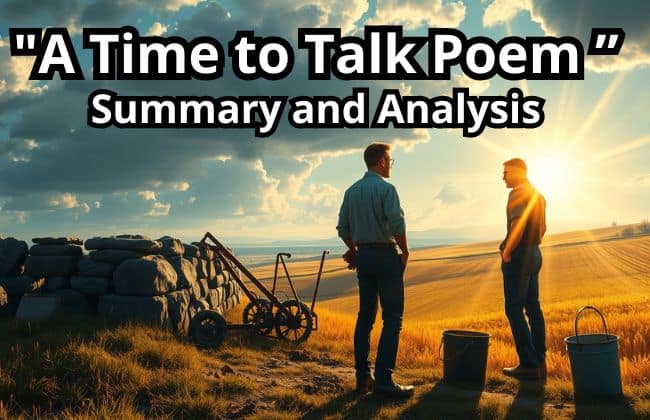
A Time to Talk” is a thought-provoking poem by the renowned American poet Robert Frost. Published in 1916, this brief yet powerful work explores the theme of human connection and the importance of making time for meaningful conversations.
The poem centers on a speaker who, despite being immersed in work, chooses to pause and engage with a passing friend. Through this act, Frost subtly emphasizes the value of relationships over productivity—a theme that feels timeless and universally relatable.
True to his characteristic style, Frost employs plain language, vivid imagery, and a conversational tone to highlight the beauty and depth of ordinary life.
In the following analysis, we will delve deeper into the literary devices, themes, and overall significance of “A Time to Talk,” examining how Frost’s words continue to resonate with readers more than a century after their publication.
Table of Contents
A Time to Talk by Robert Frost
When a friend calls to me from the road
And slows his horse to a meaning walk,
I don't stand still and look around
On all the hills I haven't hoed,
And shout from where I am, What is it?
No, not as there is a time to talk.
I thrust my hoe in the mellow ground,
Blade-end up and five feet tall,
And plod: I go up to the stone wall
For a friendly visit.
Summary
A Time to Talk” by Robert Frost is a reflective poem that emphasizes the importance of friendship and taking time for personal connections.
The poem describes a moment when the speaker’s friend approaches, calling from the road. Despite being immersed in work, the speaker chooses to pause, set his tools aside, and meet his friend at the stone wall for a conversation. This deliberate act symbolizes the prioritization of relationships over the demands of labor.
Frost succinctly highlights the value of human connection, suggesting that friends and their needs should never be postponed, even in the midst of duties.
Themes in “A Time to Talk”
The poem contains several significant themes:
a. Friendship and Connection
The central theme of the poem revolves around the idea that relationships are more valuable than work. Frost illustrates how true companions deserve undivided attention when they reach out.
b. Choices and Priorities
Through the speaker’s decision to leave his task and engage with his friend, Frost underscores the tension between life’s obligations and the need for personal interaction. The poem advocates for choosing human warmth over productivity.
c. The Transience of Time
The brevity of life’s moments and the necessity of seizing time to foster meaningful connections are subtly expressed. Work can wait, but moments with loved ones are fleeting.
Structure and Form
- Form: The poem is a single stanza comprised of 10 lines. This compact structure conveys the simplicity and directness of the message Frost wishes to communicate.
- Rhyme Scheme: The rhyme scheme follows an irregular pattern, abcadbceed. This loose arrangement mirrors the organic, unstructured nature of conversation and friendship.
- Meter: The poem uses varying line lengths, most falling between six and nine syllables. This irregular rhythm lends a conversational tone to the poem, reinforcing its theme of casual, heartfelt interaction.
- Tone: The tone is warm and thoughtful, reflecting the speaker’s care and mindfulness toward his friend.
Literary Devices
Frost employs several literary devices that enhance the poem’s emotional and thematic depth. Here are the key ones:
a. Imagery
The poem is rich with visual and kinesthetic imagery, immersing the reader in the rural setting and the speaker’s actions:
- “When a friend calls to me from the road…” evokes a vivid auditory scene of a friend hailing with a sense of urgency.
- “Blade-end up and five feet tall” paints a clear image of the hoe being firmly placed in the ground, symbolizing work momentarily set aside.
b. Symbolism
- The hoe symbolizes the burdens of labor, while placing it upright in the ground signifies the speaker’s decision to pause and prioritize his friend.
- The stone wall functions as both a literal meeting point and a metaphor for unity and connection between individuals.
c. Alliteration
Frost incorporates alliteration to create rhythm and enhance the poem’s flow:
- “Hills I haven’t hoed” uses the repetition of the “h” sound, mirroring the monotony of labor.
- “Blade-end up” draws attention to the deliberate action of setting work aside.
Analysis of each part
Lines 1-2:
"When a friend calls to me from the road
And slows his horse to a meaning walk…"
Here, Frost introduces a moment of interruption in the speaker’s routine. The image of a friend calling out and deliberately slowing his horse signals that the friend values this interaction and intends to connect meaningfully. The friend isn’t casual in passing by—this act demonstrates his effort to reach out, showing the importance of their relationship.
Lines 3-5:
"I don't stand still and look around
On all the hills I haven't hoed,
And shout from where I am, 'What is it?'"
Through these lines, the speaker reflects on his choice not to ignore or dismiss his friend. He doesn’t prioritize his work or allow the uncompleted tasks before him—the “hills I haven’t hoed”—to control his response. Instead of yelling from a distance, which would be impersonal and detached, he chooses not to take the easy way out.
Frost emphasizes that acknowledging a friend’s effort requires more than a superficial or distant response—it takes action.
Line 6:
"No, not as there is a time to talk."
This simple line carries a powerful declaration. The speaker recognizes that there is a right time for everything, and this moment belongs to friendship, not to work. Frost shows the speaker making a deliberate choice—pausing the duties of life to prioritize human connection because such moments can’t always wait.
Lines 7-8:
"I thrust my hoe in the mellow ground,
Blade-end up and five feet tall…"
Through this specific action, Frost conveys the speaker’s decisiveness. By placing the hoe firmly and upright, the speaker symbolizes that the work is intentionally left as it is. The balanced and upright tool is like a pause in life, signaling readiness to reconnect. The mention of “mellow ground” suggests the speaker’s acceptance and ease with stepping away from his tasks.
Lines 9-10:
"And plod: I go up to the stone wall
For a friendly visit."
The word “plod” evokes a sense of fatigue or effort, highlighting that while pausing work and walking toward his friend might require effort, it’s well worth it. The “stone wall” represents a meeting place where they connect, a space that symbolizes unity and companionship.
The phrase “for a friendly visit” could be seen as the heart of the poem; it’s not about grand gestures or elaborate plans but about simply prioritizing time with a friend in a quiet, honest way.
You might also like: