Easter is a time of celebration and reflection within the Christian community, marking the resurrection of Jesus Christ.
In this context, poetry becomes a powerful tool for expressing our faith, gratitude, and love towards Christ.
In the church, Easter poems hold a special place during liturgical celebrations and community activities. These lyrical compositions help us lift our hearts, strengthen our devotion, and convey the Good News in a creative and memorable way.
Whether recited during worship, included in church bulletins, or shared at community gatherings, Easter poems serve as a powerful medium to convey messages of hope, renewal, and love.
Below, we invite you to discover a selection of inspiring Easter poems that we have specially prepared to share in your church.
Immerse yourself in the beauty of these verses and let the spirit of the Resurrection renew your faith and fill your heart with joy.
Table of Contents
- 1 1) ‘Easter Day’ By Christina Rossetti
- 2 2) ‘Easter’ By Edmund Spenser
- 3 3) Easter Wings By George Herbert
- 4 4) “On Easter Day” by Oscar Wilde
- 5 5) “An Easter Prayer” by Helen Steiner Rice
- 6 6) ‘Good Friday Evening’ by Christina Rossetti
- 7 7) “Seven Stanzas at Easter” de John Updike
- 8 8) ‘Easter Hymn’ by A.E. Housman
- 9 9) ‘An Easter Flower Gift’ by John Greenleaf Whittier
- 10 10) “Easter Week” by Charles Kingsley
- 11 Themes in Easter Poems
- 12 How to Choose the Right Easter Poem for Your Church
1) ‘Easter Day’ By Christina Rossetti
The poem “Easter Day” by Christina Rossetti celebrates the resurrection of Christ and the renewal of spring as metaphors for new beginnings and eternal hope.
Rossetti evokes images of rejuvenated nature and humanity joyfully celebrating victory over death, inviting everyone to join in a song of love and rebirth.
This poem aligns with the spirit of Easter, highlighting themes of rebirth and redemption that are central to the Christian celebration of Jesus’s resurrection.
Words cannot utter
Christ His returning:
Mankind, keep jubilee,
Strip off your mourning,
Crown you with garlands,
Set your lamps burning… See full poem
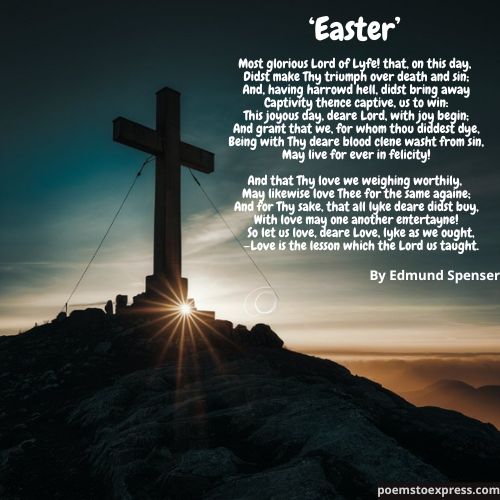
2) ‘Easter’ By Edmund Spenser
Edmund Spenser’s poem “Easter,” also known as Sonnet 68 from the Amoretti cycle, is a celebration of Christ’s triumph over death and sin, resonating with the central themes of Easter.
In this sonnet, Spenser highlights Christ’s resurrection as a victory over death and a liberation of humanity from its sins, a theme that invites the faithful to live in perpetual happiness thanks to the divine sacrifice. Additionally, the poem links this triumph with divine and human love, urging readers to love one another as a reflection of the love that Christ demonstrated.
This sonnet is not only a devout work celebrating the Easter holiday but also a reflection of Spenser’s deep spirituality and his ability to weave theological complexities with his personal poetic art.
Most glorious Lord of Lyfe! that, on this day,
Didst make Thy triumph over death and sin;
And, having harrowd hell, didst bring away
Captivity thence captive, us to win:
This joyous day, deare Lord, with joy begin;
And grant that we, for whom thou diddest dye,
Being with Thy deare blood clene washt from sin,
May live for ever in felicity!.. See full poem
3) Easter Wings By George Herbert
This poem is written in a visual form, using its structure to emphasize the themes of fall and redemption.
Each stanza is typographically arranged to simulate a pair of bird wings, symbolizing the aspiration for spiritual ascent through suffering and divine grace.
The theme focuses on the humble and fallen condition of man, and the hope for restoration and elevation through union with the divinity, reflecting the resurrection of Christ celebrated at Easter.
Lord, who createdst man in wealth and store,
      Though foolishly he lost the same,
            Decaying more and more,
                  Till he became
                        Most poore:
                        With thee
                  O let me rise… See full poem
4) “On Easter Day” by Oscar Wilde
The poem offers a critical reflection on the celebration of Easter in Rome, contrasting the magnificence of the Pope with the humility of Jesus Christ.
Wilde describes the Easter procession in detail, highlighting the grandeur and pomp with which the Pope is venerated, almost as a divine figure.
However, the poem points out a disconnection between this ostentation and the life of Jesus, which was characterized by humility and suffering.
This juxtaposition serves as a critique of religious institutions which, according to Wilde, can stray from the true messages of Christianity.
The silver trumpets rang across the Dome:
The people knelt upon the ground with awe:
And borne upon the necks of men I saw,
Like some great God, the Holy Lord of Rome.
Priest-like, he wore a robe more white than foam,
And, king-like, swathed himself in royal red,… See full poem
5) “An Easter Prayer” by Helen Steiner Rice
“An Easter Prayer” by Helen Steiner Rice is a poem that reflects on the beauty and spiritual renewal of the Easter season.
Through vivid imagery of spring and nature, Rice expresses a desire for spiritual awakening and renewal in the hearts of the faithful.
The poem encourages readers to see the majesty of God in all aspects of life and to find comfort in the reassurance that they are cared for by a higher power.
God, give us eyes to see
the beauty of the Spring,
And to behold Your majesty
in every living thing -

And may we see in lacy leaves
and every budding flower
The hand that rules the universe
with gentleness and power -… See full poem
6) ‘Good Friday Evening’ by Christina Rossetti
In this poem, there is a profound reflection on the poet’s emotional disconnection from the crucifixion of Christ, a theme that contrasts with the intense reactions of other witnesses according to the scriptures.
Rossetti uses this framework to explore her inner struggle and her longing for a deeper connection with the suffering of Christ.
Throughout the poem, she expresses a kind of spiritual coldness, wondering why she cannot cry like the others, though she recognizes the magnitude of Christ’s sacrifice.
The poem culminates with a plea for emotional and spiritual redemption, reflecting Rossetti’s desire to overcome her emotional detachment and truly connect with the Christian faith.
No Cherub's heart of hand for us might ache,
  No Seraph's heart of fire had half sufficed:
Thine own were pierced and broken for our sake,
      O Jesus Christ.
Therefore we love Thee with our faint good-will,
  We crave to love Thee not as heretofore,
To love Thee much, to love Thee more, and still
      More and yet more.

7) “Seven Stanzas at Easter” de John Updike
This poem addresses Christ’s resurrection in a very direct and emphatic manner, challenging metaphorical or watered-down interpretations of this central event of Christianity.
The author of the poem insists on the physical reality of the resurrection, emphasizing that if Christ was resurrected, it was in a physical body, with all the miraculous implications this holds for the Christian faith.
It urges recognition of the resurrection not as a symbol or a metaphor, but as a concrete and tangible event that underpins the entire structure of the Church.
Make no mistake: if he rose at all
It was as His body;
If the cell’s dissolution did not reverse, the molecule reknit,
The amino acids rekindle,
The Church will fall.
It was not as the flowers,
Each soft spring recurrent;
It was not as His Spirit in the mouths and fuddled eyes of the
Eleven apostles;
It was as His flesh; ours… See full poem
8) ‘Easter Hymn’ by A.E. Housman
Easter Hymn” by A.E. Housman, a poet known for his religious skepticism, presents a profound reflection on the death and possible resurrection of Christ.
Across two stanzas, the poem contrasts the uncertainty about the true impact of Christ’s death with the possibility of his divinity and redeeming power.
The work captures a yearning to believe in something beyond death, reflecting on the perpetual impact and hope that the figure of Christ offers, even to those who struggle with faith.
If in that Syrian garden, ages slain,
You sleep, and know not you are dead in vain,
Nor even in dreams behold how dark and bright
Ascends in smoke and fire by day and night
The hate you died to quench and could but fan,
Sleep well and see no morning, son of man.

But if, the grave rent and the stone rolled by,
At the right hand of majesty on high
You sit, and sitting so remember yet
Your tears, your agony and bloody sweat,
Your cross and passion and the life you gave,
Bow hither out of heaven and see and save.
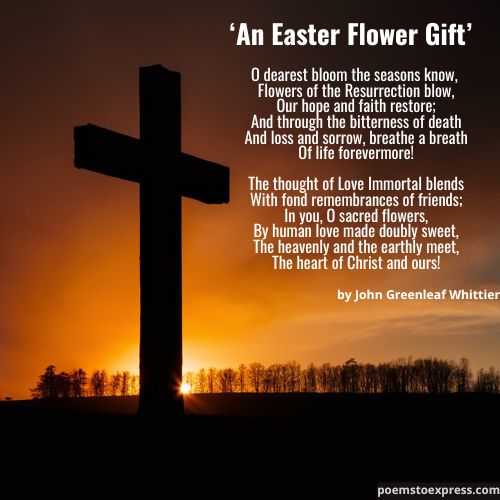
9) ‘An Easter Flower Gift’ by John Greenleaf Whittier
In “An Easter Flower Gift,” John Greenleaf Whittier uses Easter flowers to explore themes of renewal and eternal hope.
The flowers, emblems of the resurrection, symbolize the promise of new life and the intersection of divine love with human affection.
Through this link, the poem distills a sense of comfort and promise in the face of adversity, reflecting how nature and memories can restore hope and faith.
This work offers a profound reflection on how earthly elements can evoke the presence and teachings of the sacred, especially in times of loss.
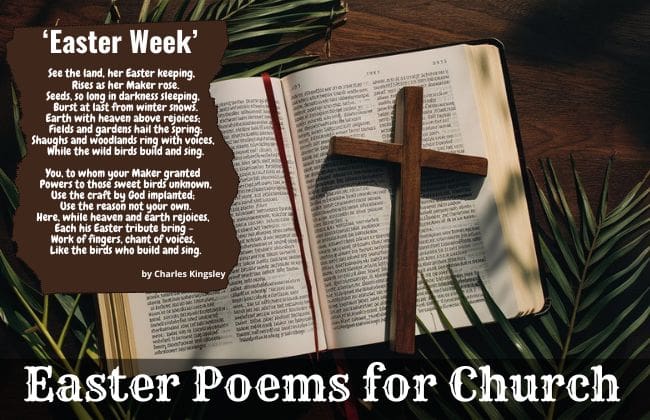
10) “Easter Week” by Charles Kingsley
The poem “Easter Week” by Charles Kingsley celebrates the arrival of spring and its connection to Easter, emphasizing resurrection and rebirth both in nature and in the human spirit.
Through vivid imagery of the earth awakening from winter, Kingsley evokes the renewal that follows a period of darkness and cold, likening it to the resurrection of Christ.
The poem encourages people to use their God-given gifts to create and contribute to the world, similar to how birds build and sing in spring.
  See the land, her Easter keeping,
        Rises as her Maker rose.
    Seeds, so long in darkness sleeping,
        Burst at last from winter snows.
    Earth with heaven above rejoices;
        Fields and gardens hail the spring;
    Shaughs and woodlands ring with voices,
        While the wild birds build and sing.

    You, to whom your Maker granted
        Powers to those sweet birds unknown,
    Use the craft by God implanted;
        Use the reason not your own.
    Here, while heaven and earth rejoices,
        Each his Easter tribute bring -
    Work of fingers, chant of voices,
        Like the birds who build and sing.
Themes in Easter Poems
Easter poems for church services often explore profound and spiritually significant themes that resonate with the essence of the Easter celebration.
Here are some of the most common themes found in Easter poems:
1. Sacrifice and Redemption
- Sacrifice: Poems focusing on sacrifice often highlight the immense love and selflessness of Jesus, who gave His life for the sins of the world. These poems might delve into the emotional and physical suffering endured on the cross.
- Redemption: They often convey a sense of gratitude and awe for the transformative power of Jesus’ sacrifice.
2. Resurrection and New Life
The resurrection of Jesus Christ is the cornerstone of Easter, symbolizing victory over death and the promise of eternal life.
- Resurrection: They often evoke feelings of triumph, joy, and hope, emphasizing the power of God to overcome death.
- New Life: These poems celebrate the new life that believers receive through Christ’s resurrection. They may focus on themes of renewal, rebirth, and the beginning of a new spiritual journey.
3. Love and Forgiveness
Easter is also a time to reflect on the boundless love and forgiveness offered by Jesus Christ.
- Love: Explore the deep, unconditional love that Jesus has for humanity. They often highlight the compassionate and nurturing aspects of His character, inspiring believers to love one another as He loves them.
- Forgiveness: They often convey a message of healing and reconciliation, encouraging believers to seek and offer forgiveness in their own lives.
How to Choose the Right Easter Poem for Your Church
Selecting the perfect Easter poem for your church can enhance the spiritual experience and resonate deeply with your congregation.
Here are some key considerations to help you make the right choice:
1. Understanding Your Congregation
Every church has a unique congregation with its own set of preferences, traditions, and spiritual needs. When choosing an
Easter poem, consider:
- Demographics: Are the majority of your congregants young families, elderly members, or a mix of all ages?
- Cultural Background: Does your congregation have a specific cultural or ethnic background that might influence their appreciation for certain themes or styles?
- Spiritual Maturity: Are your members new to the faith, or do they have a deep, long-standing relationship with their beliefs?
2. Matching the Poem to the Sermon
An Easter poem can serve as a powerful complement to the sermon, reinforcing its message and themes.
To ensure cohesion:
- Identify the Core Message: What is the main message of the sermon? Is it about hope, resurrection, sacrifice, or redemption?
- Select a Poem with Similar Themes: Choose a poem that mirrors the sermon’s themes, enhancing the overall narrative of the service.
- Consider the Tone: If the sermon is solemn and reflective, a poem with a similar tone will be more appropriate. Conversely, if the sermon is celebratory and joyous, a poem that exudes joy and triumph will be a better fit.
3. Considering the Tone and Length
The tone and length of the poem are crucial factors that can affect the flow and impact of the service.
- Tone: Ensure the tone of the poem matches the atmosphere you wish to create. A somber, reflective poem might be perfect for a Good Friday service, while a joyful, uplifting poem would be ideal for Easter Sunday.
- Length: Consider the length of the poem in relation to the overall service. A long, intricate poem might be suitable for a dedicated poetry reading segment, while a shorter, more concise poem might be better for integrating into the sermon.
You might also like: