Stephen Spender’s poem The Express offers a vivid celebration of this modern marvel, blending movement, technology, and nature into a single, lyrical experience.
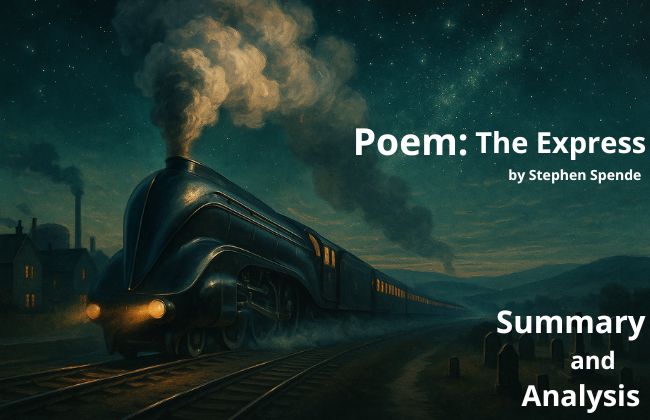
Written with Spender’s keen eye for detail and love for progress, the poem captures a distinctive moment in 20th-century literature where the machine age met poetic imagination.
Spender invites readers to experience the train not just as a mode of transportation but as a symbol of power and human ingenuity, seamlessly connecting the mechanical with the majestic. Its rhythmic flow mirrors the train’s momentum, pulling us along in awe and admiration.
This article will delve into the themes and symbolism within “The Express,” exploring how Spender finds beauty in mechanical objects and the complexities of human experience as the train travels through various settings.
Table of Contents
“The Express” by Stephen Spender
After the first powerful plain manifesto
The black statement of pistons, without more fuss
But gliding like a queen, she leaves the station.
Without bowing and with restrained unconcern
She passes the houses which humbly crowd outside,
The gasworks and at last the heavy page
Of death, printed by gravestones in the cemetery.
Beyond the town there lies the open country
Where, gathering speed, she acquires mystery,
The luminous self-possession of ships on ocean.
It is now she begins to sing—at first quite low
Then loud, and at last with a jazzy madness—
The song of her whistle screaming at curves,
Of deafening tunnels, brakes, innumerable bolts.
And always light, aerial, underneath
Goes the elate metre of her wheels.
Steaming through metal landscape on her lines
She plunges new eras of wild happiness
Where speed throws up strange shapes, broad curves
And parallels clean like the steel of guns.
At last, further than Edinburgh or Rome,
Beyond the crest of the world, she reaches night
Where only a low streamline brightness
Of phosphorus on the tossing hills is white.
Ah, like a comet through flame, she moves entranced
Wrapt in her music no bird song, no, nor bough
Breaking with honey buds, shall ever equal.
Summary
Stephen Spender’s poem The Express captures the awe-inspiring journey of a train, symbolizing the marvels and anxieties of modernity.
The poem begins with the train leaving the station, described as a majestic and almost royal entity. As it moves through urban and rural landscapes, the train becomes a metaphor for progress, blending beauty with a sense of foreboding.
Spender juxtaposes the train’s elegance with its disruptive impact on the natural and human world, ultimately portraying it as a symbol of unstoppable technological advancement.
Themes
- Modernity and Industrial Progress: The train symbolizes the technological advancements of the Industrial Revolution, representing human ambition and the transformative power of machines. Spender glorifies the train’s speed and majesty, reflecting the era’s fascination with technology.
- Romanticism in a Modern Context: Spender redefines romanticism by celebrating a mechanical object, suggesting that machines can evoke the same awe as natural phenomena.
- Ambivalence Toward Progress: While the poem admires the train’s grandeur, it subtly conveys unease about modernity’s relentless pace, hinting at potential societal harm, such as environmental disruption or dehumanization.
- Human Aspiration and Transcendence: The train’s journey beyond the town and into the unknown mirrors humanity’s quest for progress and exploration, culminating in a cosmic comparison to a comet.
Imagery and Symbolism
Imagery
Spender employs vivid imagery to bring the train’s journey to life:
Urban Imagery: The train passes “houses which humbly crowd outside” and “the gasworks,” evoking the gritty reality of industrial towns. The “heavy page of death, printed by gravestones in the cemetery” creates a somber contrast to the train’s vitality.
Rural Imagery: As the train enters the “open country,” it gains “luminous self-possession” and moves through “metal landscapes,” blending natural and mechanical elements.
Cosmic Imagery: The train’s final depiction as a “comet through flame” soaring “beyond the crest of the world” elevates it to a celestial level, emphasizing its grandeur.
Symbolism
- The Train: Represents modern industrial civilization and human progress. Its unstoppable nature reflects the relentless march of technology.
- The Whistle: Symbolizes a “manifesto” or declaration of modernity, announcing the train’s presence and the arrival of a new era.
- Cemetery: Juxtaposed with the train’s vitality, it symbolizes death and the static past, highlighting the contrast between tradition and progress.
- The Comet: The train’s final comparison to a comet suggests transcendence, speed, and a fleeting, brilliant presence that reshapes perceptions of the world.
Poetic Devices
Spender’s use of poetic devices enhances the poem’s rhythmic and emotional impact:
Personification: The train is repeatedly referred to as “she,” imbued with feminine qualities like grace and majesty, as in “gliding like a queen” and “without bowing and with restrained unconcern.” This anthropomorphism elevates the train to a living, regal entity.
Metaphor and Simile: The train is compared to a queen, a ship, and a comet, with similes like “parallels clean like trajectories from guns” and “like a comet through flame,” emphasizing its power and speed.
Alliteration: Phrases like “powerful plain manifesto” and “black statement of pistons” create a rhythmic flow, mimicking the train’s motion.
Free Verse with Iambic Traces: The poem is primarily free verse but includes traces of iambic pentameter (e.g., “She pass’-es the hous’-es which humb’-ly crowd outside”), adding a subtle rhythm that mirrors the train’s movement.
Onomatopoeia and Sound: The “song of her whistle screaming at curves” and “deafening tunnels, brakes, innumerable bolts” evoke the train’s mechanical sounds, enhancing the sensory experience.
Detailed Analysis
Lines 1–7: The Train’s Departure
After the first powerful plain manifesto
The black statement of pistons, without more fuss
But gliding like a queen, she leaves the station.
Without bowing and with restrained unconcern
She passes the houses which humbly crowd outside,
The gasworks and at last the heavy page
Of death, printed by gravestones in the cemetery.
The poem opens with the train’s departure described as a “powerful plain manifesto,” suggesting a bold and unadorned statement of intent. The “black statement of pistons” emphasizes the mechanical power driving the train.
The train is personified as a queen, gliding gracefully past houses and a cemetery, symbolizing the passage from the mundane to the extraordinary. This juxtaposition highlights the intrusion of modern technology into traditional settings.
Lines 8–14: Gaining Speed and Mystery
Beyond the town there lies the open country
Where, gathering speed, she acquires mystery,
The luminous self-possession of ships on ocean.
It is now she begins to sing—at first quite low
Then loud, and at last with a jazzy madness—
The song of her whistle screaming at curves,
Of deafening tunnels, brakes, innumerable bolts
As the train moves into the open countryside, it “gathers speed” and “acquires mystery,” likened to ships on the ocean.
This metaphor suggests the train’s transformation into a majestic and enigmatic force. The evolving whistle, from low to loud and “jazzy madness,” reflects the increasing energy and presence of the train.
Lines 15–21: Through Metal Landscapes
And always light, aerial, underneath
Goes the elate metre of her wheels.
Steaming through metal landscape on her lines
She plunges new eras of wild happiness
Where speed throws up strange shapes, broad curves
And parallels clean like the steel of guns.
At last, further than Edinburgh or Rome,
The train’s journey through “metal landscapes” introduces new eras of happiness, with speed creating “strange shapes” and parallels like steel guns. This imagery evokes the industrial revolution’s impact, where technology reshapes the environment. The train’s movement is rhythmic, symbolizing the relentless march of progress.
Lines 22–27: Reaching the Night
Beyond the crest of the world, she reaches night
Where only a low streamline brightness
Of phosphorus on the tossing hills is white.
Ah, like a comet through flame, she moves entranced
Wrapt in her music no bird song, no, nor bough
Breaking with honey buds, shall ever equal.
Finally, the train reaches the night, where only a low streamline brightness of phosphorus on the tossing hills is visible. It moves “like a comet through flame,” entranced in its music.
This celestial imagery elevates the train to a sublime level, suggesting its transcendence beyond mere machinery. The comparison to a comet emphasizes its brilliance and the awe it inspires.
You might also like: