Robert Frost’s The Road Not Taken is one of the most iconic and frequently quoted poems in modern literature.
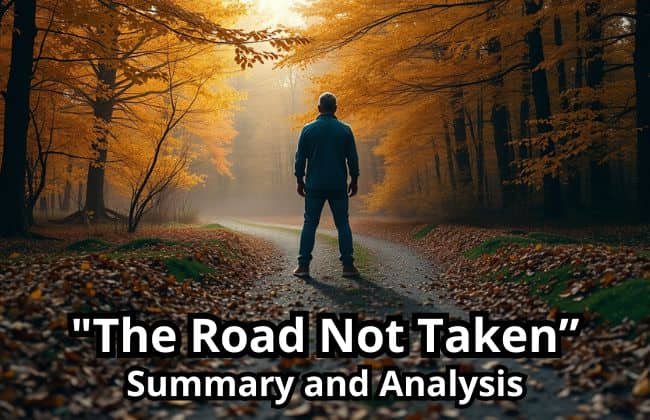
Written in 1916, this deceptively simple yet profoundly deep piece captures the universal experience of choice and its lasting impact on our lives. It narrates the moment of standing at a literal and metaphorical crossroads, where the speaker must decide between two diverging paths in a forest.
The poem resonates with themes of uncertainty, reflection, and the enduring curiosity about the road “less traveled by.” Its imagery and rhythm evoke the weight of decision-making, while its open-ended conclusion invites readers to ponder their own choices.
Though often interpreted as a celebration of individuality, the poem also subtly questions how we rationalize our decisions in hindsight. Its timelessness comes not only from its relatability but also from the layers of meaning hidden beneath its conversational tone.
This post will explore the depths of Frost’s masterpiece, unraveling the choices within its lines.
The Road Not Taken by Robert Frost
Two roads diverged in a yellow wood,
And sorry I could not travel both
And be one traveler, long I stood
And looked down one as far as I could
To where it bent in the undergrowth;

Then took the other, as just as fair,
And having perhaps the better claim,
Because it was grassy and wanted wear;
Though as for that the passing there
Had worn them really about the same,

And both that morning equally lay
In leaves no step had trodden black.
Oh, I kept the first for another day!
Yet knowing how way leads on to way,
I doubted if I should ever come back.

I shall be telling this with a sigh
Somewhere ages and ages hence:
Two roads diverged in a wood, and I—
I took the one less traveled by,
And that has made all the difference.
Summary
“The Road Not Taken,” one of Robert Frost’s most well-known poems, explores the nature of decision-making and its impact on life.
The speaker describes a walk through a yellow-tinged autumn wood where they encounter a fork in the road. Faced with two paths, they ultimately choose one, which they perceive as less traveled. However, upon further reflection, the speaker acknowledges that both roads seemed similarly worn. The poem ends with the speaker imagining that, in the future, they will frame this decision as life-changing, declaring that their choice “made all the difference.”
The poem illustrates a universal human conflict between choices and the longing to know the outcome of the road not taken.
Themes
1. Choices and Their Consequences
The primary theme of the poem revolves around choices. The fork in the road becomes a metaphor for the decisions that shape our lives.
The speaker’s uncertainty and hesitant deliberation highlight the difficulty we face in choosing a clear path without foreknowing its consequences.
By taking one road, the narrator loses the opportunity to explore the other, underscoring the permanence of certain life decisions.
2. Individualism
The poem is often interpreted as a celebration of individualism. The speaker chooses a “less traveled” road, which can be seen as a metaphor for forging a unique or unconventional path in life.
However, the poem’s self-awareness and subtle irony complicate this view, as the speaker admits the paths are “really about the same.”
3. Regret and Reflection
At its heart, the poem reflects on how choices can evoke a lingering sense of regret or curiosity about “what might have been.”
Even as the speaker predicts they will romanticize this decision in the future, there is an awareness that this narrative might be shaped, rewritten, or exaggerated over time.
This theme of memory and constructed meaning adds emotional complexity to the poem’s meditation on decision-making.
4. Uncertainty
The speaker acknowledges the impossibility of predicting where the chosen road will lead. This reflects the general human condition of uncertainty and the need to make choices despite incomplete knowledge about their outcomes.
Structure and Form
Stanza Form
The poem is composed of four quintains (five-line stanzas), adding up to a total of 20 lines. Each stanza presents a distinct phase in the decision-making process, from choosing the road to reflecting on its significance.
Rhyme Scheme
The poem employs a regular ABAAB rhyme scheme throughout each stanza. This consistency in rhyme creates a sense of order and mirrors the deliberate thought process of the speaker.
Meter
Written in iambic tetrameter, the poem utilizes four metrical feet per line, where an unstressed syllable is followed by a stressed one.
Frost, however, incorporates metrical variations, such as anapests (unstressed-unstressed-stressed), to create a conversational, almost reflective tone.
For example:
“Two roads di verged in a yel low wood.”
Tone
The poem’s tone is introspective and tinged with both wistfulness and ambiguity. The speaker’s musings oscillate between deliberate contemplation and a hint of regretful sighing.
Literary Devices
Metaphor
The central metaphor of the poem is the forked road, symbolizing life’s myriad choices. The act of choosing one road while forsaking another reflects the inevitability of decision-making in life.
Irony
The poem is steeped in subtle irony. While the speaker claims to have taken the less traveled path, they eventually admit that both paths were equally worn.
This suggests that the emphasis placed on nonconformity or individuality may simply be a constructed narrative made after the fact.
Symbolism
Several symbols enrich the poem:
- The Yellow Wood: Represents transition or change, as autumn often does in literature.
- The Roads: Symbolize life’s choices, each leading to unknown outcomes.
- Leaves Untrodden Black: Suggest new beginnings or opportunities that have yet to be explored.
Repetition
Repetition is used to emphasize central ideas:
- The phrase “Two roads diverged” is repeated as both an opening and closing motif, bookending the poem and reinforcing its thematic focus on decisions.
Imagery
Frost employs vivid imagery to immerse the reader in the speaker’s world. Such details as the “yellow wood” and “leaves no step had trodden black” paint a vivid autumnal scene, while also resonating with the speaker’s inner emotional landscape.
Stanza-by-Stanza Analysis
Stanza 1
Two roads diverged in a yellow wood,
And sorry I could not travel both
And be one traveler, long I stood
And looked down one as far as I could
To where it bent in the undergrowth;
The opening stanza immediately establishes the poem’s central metaphor of diverging roads as a representation of life’s choices. The “yellow wood,” rich with imagery, sets the scene during autumn—a season symbolic of transitions and change. This transitional period mirrors the speaker’s internal state of being at a crossroads. The tone is introspective and conveys a sense of hesitation as the speaker acknowledges the impossibility of exploring both paths.
The phrase “long I stood” underscores a moment of deep contemplation, emphasizing the weight of the decision faced. The imagery of looking “down one as far as I could / To where it bent in the undergrowth” conveys the limited foresight we often have in life.
The road bending symbolizes the unpredictability of the future, highlighting a sense of uncertainty that acts as a recurring theme throughout the poem. Frost also uses enjambment here, with the lines flowing into each other, mimicking the speaker’s wandering thoughts.
Stanza 2
Then took the other, as just as fair,
And having perhaps the better claim,
Because it was grassy and wanted wear;
Though as for that the passing there
Had worn them really about the same,
This stanza captures the act of choice, though the decision is laced with uncertainty. The speaker chooses one path over the other but justifies it ambiguously—describing the chosen road as “just as fair” yet claiming it “wanted wear.” This line introduces irony, as later reflection reveals that neither path was significantly more or less traveled.
The notion of the road “wanting wear” gives the impression of nonconformity, suggesting that the speaker values individuality. However, Frost quickly undermines this assumption with the admission that both roads are “really about the same.” This contradiction plays with the reader’s expectations and challenges the idea of the speaker’s choice being truly unconventional.
The stanza exemplifies the human tendency to rationalize choices, even when they are based on arbitrary or equal options.
Stanza 3
And both that morning equally lay
In leaves no step had trodden black.
Oh, I kept the first for another day!
Yet knowing how way leads on to way,
I doubted if I should ever come back.
This stanza deepens the poem’s exploration of choice by capturing the fleeting nature of opportunities. The description of the roads “equally lay / In leaves no step had trodden black” suggests that both paths represent fresh, untouched possibilities.
The imagery of untrodden leaves reflects the initial excitement or lure of life’s choices. However, the idealism of leaving the first road “for another day” quickly gives way to a sobering truth: life rarely allows for second chances, as “way leads on to way.”
This is a poignant moment in the poem where the speaker exhibits self-awareness, acknowledging the improbability of revisiting the path not taken.
The tone becomes wistful, introducing a subtle sense of regret. Frost captures the inevitability of moving forward, as choices once made become the foundation for future decisions.
Stanza 4
I shall be telling this with a sigh
Somewhere ages and ages hence:
Two roads diverged in a wood, and I—
I took the one less traveled by,
And that has made all the difference.
The final stanza shifts into a future perspective as the speaker imagines how they might recount this moment in later years. The phrase “I shall be telling this with a sigh” is deliberately ambiguous, leaving readers unsure if the sigh conveys satisfaction, regret, or resignation. This intentional vagueness invites multiple interpretations, allowing the poem to resonate personally with each reader.
The repeated motif of “Two roads diverged in a wood” reappears, framing the poem and reinforcing its central metaphor. The line “I took the one less traveled by” captures the human desire to attribute meaning and individuality to our decisions. However, this retrospection is complicated by the earlier acknowledgement that the two roads were identical.
You might also like: