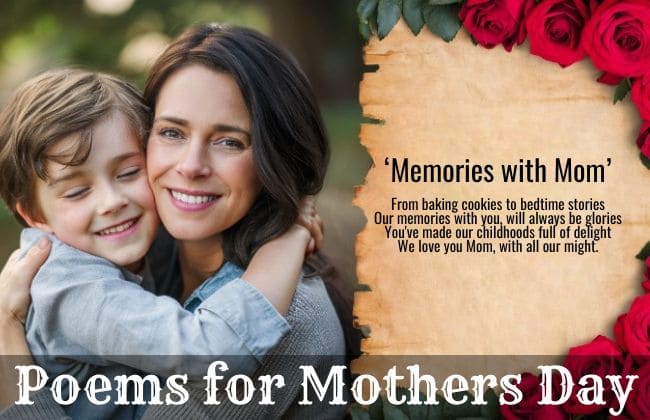
Mother’s Day brings a wonderful opportunity to celebrate the incredible women who shape our lives. For children, expressing just how much they love their mom can sometimes feel like a daunting task.

While handmade crafts and breakfast in bed are always appreciated, there is something uniquely magical about sharing a poem. Simple, heartfelt poetry gives kids a beautiful framework to articulate their big feelings, capturing the sweet, innocent, and profound bond they share with their mothers.
A few simple rhymes can bring tears of joy to any mom’s eyes and create a memory that lasts a lifetime. The best part? Kids don’t need to be professional writers to craft something truly special and touching.
From sweet and silly verses to tender and emotional lines, the right poem can make this Mother’s Day truly unforgettable.
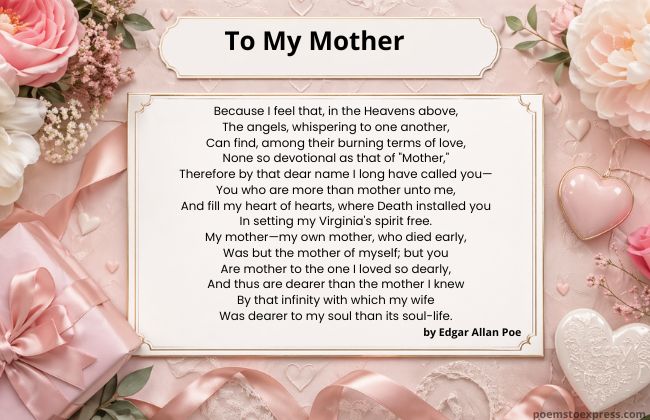
To My Mother by Edgar Allan Poe
The poem elevates the concept of motherhood to a divine status, portraying it as the ultimate expression of love. Poe expresses profound gratitude to Maria, valuing her more than his biological mother because she gave him Virginia, his greatest love.
Through vivid imagery and emotional depth, Poe intertwines themes of love, loss, and reverence. The poem’s structure and language emphasize the sacred bond of motherhood, transcending biological ties, and highlight the solace and connection Poe found in Maria during his grief.
Because I feel that, in the Heavens above,
The angels, whispering to one another,
Can find, among their burning terms of love,
None so devotional as that of "Mother,"
Therefore by that dear name I long have called you—
You who are more than mother unto me,
And fill my heart of hearts, where Death installed you
In setting my Virginia's spirit free.
My mother—my own mother, who died early,
Was but the mother of myself; but you
Are mother to the one I loved so dearly,
And thus are dearer than the mother I knew
By that infinity with which my wife
Was dearer to my soul than its soul-life.
Mother o’ Mine by Rudyard Kipling
“Mother o’ Mine” is a poignant tribute to a mother’s unconditional love. Written as a dedication to his 1892 book The Light That Failed, the poem explores the enduring nature of maternal devotion.
Through escalating scenarios, execution, drowning, and damnation, Kipling illustrates how a mother’s love, grief, and prayers persist beyond disgrace, loss, and even moral condemnation.
The refrain “Mother o’ mine” emphasizes the speaker’s reliance on this unwavering bond. The poem’s tension lies in its final stanza, where maternal prayer challenges the permanence of damnation, suggesting a mother’s faith transcends judgment.
If I were hanged on the highest hill,
Mother o’ mine, O mother o’ mine!
I know whose love would follow me still,
Mother o’ mine, O mother o’ mine!
If I were drowned in the deepest sea,
Mother o’ mine, O mother o’ mine!
I know whose tears would come down to me,
Mother o’ mine, O mother o’ mine!
If I were damned of body and soul,
I know whose prayers would make me whole,
Mother o’ mine, O mother o’ mine!

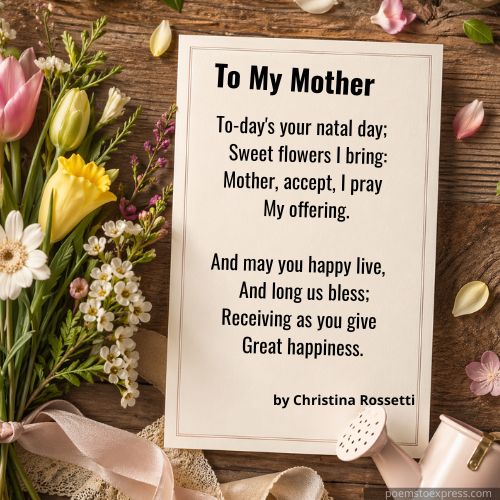
To My Mother by Christina Rossetti
“To My Mother” is a brief but deeply affectionate tribute that turns a birthday gift into a declaration of gratitude. The speaker offers flowers, yet the real gift is emotional: love, respect, and a wish that the mother may continue blessing the family with the same happiness she gives them.
The poem expresses tenderness through simplicity. Its short lines, gentle rhythm, and direct language make the feeling sound sincere rather than ornate. What Rossetti seems to value most is maternal generosity: the mother is presented as a source of comfort, stability, and joy.
To-day's your natal day;
   Sweet flowers I bring:
Mother, accept, I pray
   My offering.

And may you happy live,
   And long us bless;
Receiving as you give
   Great happiness.
My Gift to You by Anonymous
My Gift to You is a heartfelt in which a child humbly offers love as the only and greatest gift they can give. The author opens by acknowledging the absence of material wealth, redirecting attention toward something far more valuable: emotional devotion expressed through hugs, prayer, and enduring love.
This contrast between worldly riches and heartfelt sincerity forms the poem’s central message. The closing lines deliver the poem’s most powerful idea, that a mother herself is the true gift.
I have no gold, no jewels to bring,
only my heart and this small offering
a lifetime of hugs, a whispered prayer,
and love that grows deeper beyond compare.

Accept these words on your special day,
as I learn from your kindness along the way;
may you always know, through all that we do,
there is no greater gift than having you.
Moonward by Anonymous
Moonward is a tender tribute to a mother’s transformative love, written from a child’s perspective. The author uses luminous natural imagery, sunlight, morning dew, color after rain to convey how a mother’s presence turns fear and uncertainty into beauty and safety.
The poem suggests that a mother is not merely a person but a felt presence woven into every gentle, truthful moment of life.
Your love is like sunlight on morning dew,
turning my fears into wonder and gold —
I see you in every soft thing that is true,
in the warmth of a story quietly told.

You are more than a face in my memory's frame,
you are color and brightness and calm after rain;
I need not call out, for you know my name —
and in knowing it, nothing can make me afraid again.
To My Mother by Robert Louis Stevenson
It’s a brief, tender poem about memory, maternal love, and the way poetry can revive childhood. Stevenson invites his mother to read his verses so she can hear again the footsteps of the child he once was.
The poem expresses gratitude, intimacy, and the emotional power of shared remembrance. Its simple quatrain and gentle sound make the feeling immediate and sincere.
You too, my mother, read my rhymes
For love of unforgotten times,
And you may chance to hear once more
The little feet along the floor.
Mother by Lola Ridge
The poem likens a mother’s love to moonlight, which softens and beautifies harsh realities, allowing fragmented souls to see themselves in a better light. Ridge employs metaphors like cracked mirrors and broken water to explore themes of self-perception and impermanence.
The tone is reverent yet restrained, avoiding sentimentality while emphasizing the mother’s ethereal presence. Through free verse and fluid structure, Ridge captures the fleeting, impressionistic nature of memory.
Your love was like moonlight
turning harsh things to beauty,
so that little wry souls
reflecting each other obliquely
as in cracked mirrors . . .
beheld in your luminous spirit
their own reflection,
transfigured as in a shining stream,
and loved you for what they are not.

You are less an image in my mind
than a luster
I see you in gleams
pale as star-light on a gray wall . . .
evanescent as the reflection of a white swan
shimmering in broken water.
The Angel that presided o’er my birth by William Blake
“The Angel that presided o’er my birth” is a miniature statement of innocence, freedom, and spiritual self-reliance. In just three lines, Blake imagines a guardian angel telling a newborn creature that it is made of “Joy and Mirth” and should go into the world loving without depending on external support.
The poem suggests that true love is native to the soul, not something granted by society, status, or material things.
The Angel that presided o’er my birth
Said, “Little creature, form’d of Joy and Mirth,
“Go love without the help of any Thing on Earth.”
My Mother’s Name Lucha by Juan Felipe Herrera
“My Mother’s Name Lucha” is a compact homage to a mother whose identity radiates through touch, music, memory, and borderland history.
The poem reflects on her life in El Paso, Texas, and Juarez, Mexico, capturing her strength, creativity, and nurturing spirit. Through fragmented yet evocative imagery such as “gypsy dress” and “lullabies of old“. Herrera paints a vivid portrait of a woman who shaped his life and art.
The poem’s unconventional structure mirrors the fluidity of memory and emotion, emphasizing the deep connection between mother and child.
your hands my hands
kindnesses   dances   silences  sitting      you  i
                El  Paso   Texas   Segundo  Barrio
Juarez   1918           1936  in  gypsy     dress  actress
you sing        i sing we sing        lullabies of old
this     now lines now     my birth
heart now life
                                                     all life       now
                              i    bow                          to you
The Sick Child by Robert Louis Stevenson
The poem captures the disorientation and fear of childhood illness, as the child perceives the room as distorted and expresses an unnameable dread. The mother reassures the child by redirecting attention to the stillness of the night and the promise of dawn, symbolized by carts arriving and the blue light of morning.
Written in rhymed couplets with a nursery-rhyme cadence, the poem contrasts the child’s anxiety with the mother’s steady declarations.
CHILD.
O Mother, lay your hand on my brow!
O mother, mother, where am I now?
Why is the room so gaunt and great?
Why am I lying awake so late?

MOTHER.
Fear not at all: the night is still.
Nothing is here that means you ill -
Nothing but lamps the whole town through,
And never a child awake but you.

CHILD.
Mother, mother, speak low in my ear,
Some of the things are so great and near,
Some are so small and far away,
I have a fear that I cannot say,
What have I done, and what do I fear,
And why are you crying, mother dear?

MOTHER.
Out in the city, sounds begin
Thank the kind God, the carts come in!
An hour or two more, and God is so kind,
The day shall be blue in the window-blind,
Then shall my child go sweetly asleep,
And dream of the birds and the hills of sheep.
The Importance of Poems for Kids on Mother’s Day
Poetry isn’t just a school exercise; it’s one of the most powerful ways children learn to express emotions they don’t yet have words for. On Mother’s Day, poems serve a dual purpose: they honor mom and help kids grow.
Emotional and Developmental Benefits
- Builds emotional vocabulary: Poems give children language for complex feelings like gratitude, admiration, and love
- Strengthens literacy skills: Rhyme, rhythm, and structure improve reading and writing comprehension
- Boosts confidence: Reciting or presenting a poem in front of family builds public speaking skills
- Creates lasting memories: A handwritten poem becomes a keepsake mom will save for decades
- Encourages empathy: Writing about someone else’s qualities teaches children to observe and appreciate others
Choosing the Perfect Mother’s Day Poem for Kids
Selecting or writing the right poem depends on three key factors: the child’s age, the tone you want to set, and whether the child is reciting, writing, or personalizing an existing poem.
Ages 3–5: Simple and Rhyming
Very young children do best with short, repetitive, and rhyming poems. These are easy to memorize and fun to say out loud.
Look for poems with:
- Four to six lines maximum
- Simple AABB or ABAB rhyme schemes
- Concrete imagery (flowers, hugs, smiles)
Example structure: “My mommy is the best, / She puts my heart at rest. / She holds me when I cry, / Her love will never die.”
Ages 6–9: Descriptive and Personal
Children this age can write their own poems with a little guidance. Encourage them to describe what their mom does and feels like rather than just saying “I love you.” Acrostic poems (using M-O-T-H-E-R as the first letters of each line) are especially popular and easy for this age group.
Acrostic example:
M – Makes every morning feel like sunshine
O – Opens her arms whenever I’m sad
T – Teaches me to be kind every day
H – Hugs me like she never wants to let go
E – Everything she does, she does with love
R – Right beside me, always
Ages 10–13: Expressive and Creative
Older kids can explore free verse, metaphor, and storytelling in their poems. Encourage them to:
- Use a specific memory with their mom as the poem’s centerpiece
- Experiment with similes (“Her laugh is like…”)
- Write from a first-person perspective for maximum authenticity
Ages 14+: Reflective and Sophisticated
Teenagers can write deeply personal, multi-stanza poems that reflect on their relationship with their mother. Free verse works well here because it removes the constraint of rhyming and lets emotion lead the writing.
Types of Mother’s Day Poems to Consider
- Rhyming poems: Classic, fun, and easy for younger children to memorize
- Acrostic poems: Great starter format using M-O-T-H-E-R or M-O-M
- Free verse poems: No rules on rhyme or rhythm; ideal for older kids
- Haiku: Three lines (5-7-5 syllables); perfect for kids who like challenges
- Cinquain: Five-line poem with a specific syllable count; elegant and structured
- List poems: A simple numbered or bulleted list of reasons “Why I Love Mom”
Creative Ways to Present Mother’s Day Poems

Writing the poem is only half the magic, how a child delivers it makes the moment truly unforgettable. Here are some of the most creative and meaningful presentation ideas, organized by effort level.
Low Effort, High Impact
- Read it aloud at the breakfast table: Simple but incredibly moving; have the child practice so they can deliver it confidently
- Tuck it inside a flower bouquet: Roll the poem into a scroll tied with ribbon and place it among the stems
- Slip it under Mom’s pillow: A surprise discovery that turns into a private, emotional moment
Medium Effort: Craft-Based Presentations
- Decorated poem card: Write the poem on cardstock and decorate the borders with drawings, watercolors, or pressed flowers
- Framed poem: Print or handwrite the poem, frame it, and give it as wall art; mothers often display these for years
- Bookmark poem: Write a short poem on a laminated bookmark — practical and sentimental
- Poetry jar: Write several short poems or reasons “Why I Love Mom” on individual slips of paper and place them in a decorated mason jar
High Effort: Memorable Experiences
- Video recording: Film the child reciting the poem and edit in photos of the child and mom together; share it on the family group chat or at dinner
- Poetry performance at dinner: Set up a small “stage” at the dining table and have the child perform the poem like a spoken word artist
- Illustrated poetry book: Combine the poem with original drawings on each page, staple it together as a mini book, and give it as a keepsake
- Collaborative family poem: Each family member (including siblings and dad) contributes one stanza; bind them together as a full family poem
You might also like: