Love is one of life’s greatest gifts, and anniversaries are the perfect moment to celebrate it with the words your heart has always wanted to say. Whether you’ve been together for one year or fifty, finding the right way to express your feelings can sometimes feel overwhelming, but that’s exactly where poetry comes in.
Anniversary poems have a unique power to capture emotions that everyday language simply can’t. They turn ordinary moments into something timeless, transforming a simple “I love you” into a declaration that truly resonates.
From sweet and tender verses to playful and humorous lines, the right poem can say everything you’ve been feeling but never quite knew how to express.
No matter what kind of couple you are, romantic dreamers, best friends, adventure seekers, or simply two people deeply committed to each other, there’s a poem out there that perfectly reflects your unique bond.
The Anniversary by John Donne
“The Anniversary” presents love as the only force that resists time. Donne, a leading Metaphysical poet, contrasts aging kings, honors, beauty, wit, and even the sun with a bond that “hath no decay,” turning a private anniversary into a bold argument about permanence.
The speaker suggests that worldly power fades, but mutual love creates its own timeless realm, almost a kingdom where both lovers are “kings.” What the poem expresses, then, is not simple romance but confidence in love’s spiritual durability and equality.
All kings, and all their favourites,
    All glory of honours, beauties, wits,
The sun it self, which makes time, as they pass,
Is elder by a year now than it was
When thou and I first one another saw.
All other things to their destruction draw,
    Only our love hath no decay;
This no to-morrow hath, nor yesterday;
Running it never runs from us away,
But truly keeps his first, last, everlasting day.

    Two graves must hide thine and my corse;
    If one might, death were no divorce.
Alas! as well as other princes, we
—Who prince enough in one another be—
Must leave at last in death these eyes and ears,
Oft fed with true oaths, and with sweet salt tears;
    But souls where nothing dwells but love
—All other thoughts being inmates—then shall prove
This or a love increasèd there above,
When bodies to their graves, souls from their graves remove.

    And then we shall be throughly blest;
    But now no more than all the rest.
Here upon earth we're kings, and none but we
Can be such kings, nor of such subjects be.
Who is so safe as we? where none can do
Treason to us, except one of us two.
    True and false fears let us refrain,
Let us love nobly, and live, and add again
Years and years unto years, till we attain
To write threescore; this is the second of our reign.
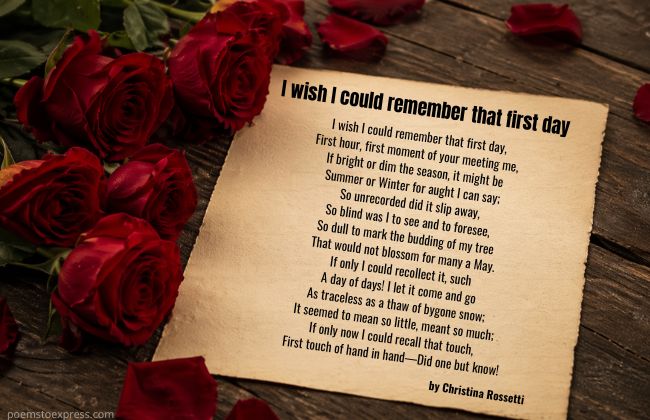
I wish I could remember that first day by Christina Rossetti
“I Wish I Could Remember That First Day” reflects on the fragility of memory and the regret of not cherishing pivotal moments. The speaker laments her inability to recall the details of her first meeting with a lover, a moment that seemed insignificant at the time but later revealed its profound importance.
Through the structure of a Petrarchan sonnet, Rossetti explores themes of love, aging, and nostalgia, emphasizing how time alters our perception of what truly matters.
The poem’s tone is one of longing and remorse, as the speaker wishes she had preserved the memory of this transformative experience.
I wish I could remember that first day,
First hour, first moment of your meeting me,
If bright or dim the season, it might be
Summer or Winter for aught I can say;
So unrecorded did it slip away,
So blind was I to see and to foresee,
So dull to mark the budding of my tree
That would not blossom for many a May.
If only I could recollect it, such
A day of days! I let it come and go
As traceless as a thaw of bygone snow;
It seemed to mean so little, meant so much;
If only now I could recall that touch,
First touch of hand in hand—Did one but know!
I Carry Your Heart with Me by E.E. Cummings
Written in free verse, the poem uses unconventional grammar and structure to emphasize intimacy and emotional depth. The speaker expresses that their beloved’s heart is inseparable from their own, symbolizing a love that transcends individuality.
Through natural imagery like the moon, sun, and stars, Cummings portrays love as eternal and universal, giving meaning to life itself. The poem’s simplicity and sincerity make it a timeless reflection on devotion, trust, and the transformative power of love.
i carry your heart with me (i carry it in
my heart) i am never without it (anywhere
i go you go, my dear; and whatever is done
by only me is your doing, my darling)
                                  i fear
no fate (for you are my fate, my sweet) i want
no world (for beautiful you are my world, my true)
and it's you are whatever a moon has always meant
and whatever a sun will always sing is you

here is the deepest secret nobody knows
(here is the root of the root and the bud of the bud
and the sky of the sky of a tree called life; which grows
higher than soul can hope or mind can hide)
and this is the wonder that's keeping the stars apart

i carry your heart (i carry it in my heart)
The Happy Husband by Samuel Taylor Coleridge
The poem intertwines themes of devotion, gratitude, and the enduring nature of love. Coleridge uses vivid imagery and rhythmic language to express the speaker’s awe at the depth of his connection with his wife, describing their union as a “promise and a mystery.”
The poem contrasts fleeting pleasures with the lasting “pulse of love” that defines their relationship. Through its tender tone and reflective style, the poem elevates domestic happiness to a sublime experience, emphasizing love’s ability to transcend the ordinary.
Oft, oft, methinks, the while with thee
I breathe, as from the heart, thy dear
And dedicated bame, I hear
A promise and a mystery,
A pledge of more than passing life,
Yea, in that very name of wife!

A pulse of love that ne'er can sleep!
A feeling that upbraids the heart
With happiness beyond desert,
That gladness half requests to weep!
Nor bless I not the keener sense
And unalarming turbulence.

Of transient joys, that ask no sting
From jealous fears, or coy denying;
But born beneath Love's brooding wing,
And into tenderness soon dying.
Wheel out their giddy moment, then
Resign the soul to love again;

A more precipitated vein
Of notes that eddy in the flow
Of smoothest song, they come, they go,
And leave their sweeter understrain
Its own sweet self-a love of thee
That seems, yet cannot greater be!
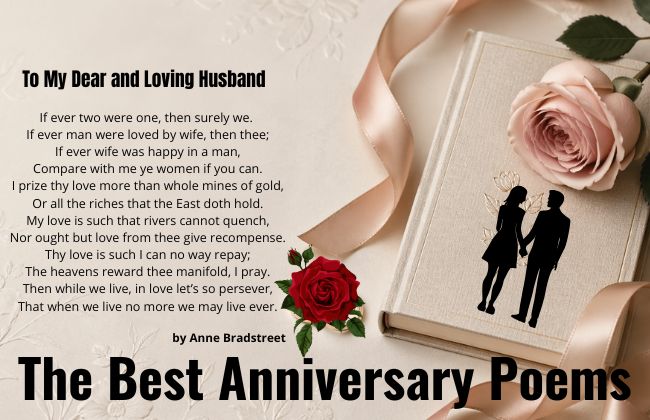
To My Dear and Loving Husband by Anne Bradstreet
Anne Bradstreet’s To My Dear and Loving Husband is a heartfelt declaration of marital love and devotion. Written in rhyming couplets, the poem celebrates the unity and eternal bond between the speaker and her husband.
Bradstreet compares their love to priceless treasures, emphasizing its value above material wealth.
She describes their connection as unquenchable and prays for divine blessings upon her husband, acknowledging that his love is beyond repayment. The poem concludes with a hope for their love to transcend mortality, uniting them forever in the afterlife.
If ever two were one, then surely we.
If ever man were loved by wife, then thee;
If ever wife was happy in a man,
Compare with me ye women if you can.
I prize thy love more than whole mines of gold,
Or all the riches that the East doth hold.
My love is such that rivers cannot quench,
Nor ought but love from thee give recompense.
Thy love is such I can no way repay;
The heavens reward thee manifold, I pray.
Then while we live, in love let’s so persever,
That when we live no more we may live ever.
A Red, Red Rose by Robert Burns
“A Red, Red Rose” is a love lyric that turns simple comparison into emotional intensity. Burns compares his beloved to a newly sprung red rose and a sweetly played melody, using familiar images to make love feel fresh, beautiful, and immediately alive. Yet the poem is not only about beauty; it is about constancy.
The speaker vows to love “till a’ the seas gang dry” and “the rocks melt wi’ the sun,” pushing romantic promise into hyperbole to express devotion beyond time, distance, and even natural limits. Written in Scots-inflected language, the poem also preserves warmth, musicality, and closeness of voice.
O my luve's like a red, red rose,
That's newly sprung in June;
O my luve's like the melodie
That's sweetly played in tune.

As fair art thou, my bonnie lass,
So deep in luve am I;
And I will luve thee still, my dear,
Till a' the seas gang dry.

Till a' the seas gang dry, my dear,
And the rocks melt wi' the sun:
O I will love thee still, my dear,
While the sands o' life shall run.

And fare thee weel, my only luve,
And fare thee weel awhile!
And I will come again, my luve,
Though it were ten thousand mile.
Love After Love by Derek Walcott
The poem reassures readers that after heartbreak or self-neglect, they will reconnect with their authentic selves. Using vivid imagery, Walcott portrays this process as a joyous reunion, likening it to greeting oneself at the door or sharing a meal.
The poem emphasizes self-love, urging individuals to cherish the “stranger” within who has always loved them. It encourages letting go of past attachments, symbolized by love letters and photographs, and embracing life fully.
Ultimately, Walcott’s message is one of healing and empowerment: to “feast on your life” and find fulfillment in self-acceptance.
The time will come
when, with elation
you will greet yourself arriving
at your own door, in your own mirror
and each will smile at the other's welcome,

and say, sit here. Eat.
You will love again the stranger who was your self.
Give wine. Give bread. Give back your heart
to itself, to the stranger who has loved you … See full poem
How Do I Love Thee? (Sonnet 43) by Elizabeth Barrett Browning
“How Do I Love Thee? (Sonnet 43)” is a timeless declaration of love that transcends physical and temporal boundaries. The speaker passionately enumerates the ways she loves her beloved, describing a love that is vast, pure, and enduring.
She compares her love to spiritual devotion, referencing faith and grace, and expresses its presence in both daily life and eternal realms. The poem’s structure as a Petrarchan sonnet enhances its lyrical flow, while its religious undertones suggest that love is both a human and divine experience.
Ultimately, the speaker envisions a love that grows stronger even after death, symbolizing its infinite and unbreakable nature.
How do I love thee? Let me count the ways.
I love thee to the depth and breadth and height
My soul can reach, when feeling out of sight
For the ends of being and ideal grace.
I love thee to the level of every day’s
Most quiet need, by sun and candle-light.
I love thee freely, as men strive for right.
I love thee purely, as they turn from praise.
I love thee with the passion put to use
In my old griefs, and with my childhood’s faith.
I love thee with a love I seemed to lose
With my lost saints. I love thee with the breath,
Smiles, tears, of all my life; and, if God choose,
I shall but love thee better after death.
[love is more thicker than forget] by E.E. Cummings
“love is more thicker than forget” is a lyrical exploration of love’s contradictory, expansive power. Cummings uses paradox and comparison to show love as something that defies simple explanation: it is “more thicker than forget” yet “more thinner than recall,” suggesting that love both resists being forgotten and is harder to grasp than memory itself.
Through vivid imagery the sea, the sky, moonlight and sunlight, the poem presents love as simultaneously mad and sane, rare and common, deep and boundless.
Its playful language and unconventional style reflect the complex emotional nature of love as something universal yet deeply personal.
love is more thicker than forget
more thinner than recall
more seldom than a wave is wet
more frequent than to fail

it is most mad and moonly
and less it shall unbe
than all the sea which only
is deeper than the sea … See full poem
The Timeless Role of Poetry in Anniversary Celebrations
Why Poetry and Love Are Inseparable
Humans have used poetry to express love for thousands of years. From ancient Egyptian love songs written on papyrus around 1300 BCE to Shakespeare’s sonnets in the 16th century and Pablo Neruda’s odes in the 20th, verse has always been the natural container for feelings too large for ordinary speech.
Poetry works differently than a card or a text message. It slows the reader down, asks for attention, and delivers emotion in concentrated form. When you give your partner a poem, whether you wrote it yourself or carefully chose one, you’re saying: I thought about you deeply enough to find the exact right words.
The Emotional Functions of Anniversary Poems
Anniversary poems serve several distinct emotional purposes at once:
- Commemoration: They mark the passage of time and honor what has been built together
- Affirmation: They restate the commitment and love that define the relationship
- Gratitude: They express thankfulness for the other person’s presence
- Reflection: They invite both partners to look back on shared memories
- Aspiration: They look forward, articulating hopes for the future
The best anniversary poems include at least one of the following elements:
- A specific reference to how long you’ve been together
- A memory or moment that only the two of you share
- An acknowledgment of growth, change, or challenge overcome
- A look forward to the future you intend to build together
You might also like: