Love has inspired some of the most beautiful and enduring verses in literary history. From Shakespeare’s passionate sonnets to Elizabeth Barrett Browning’s declarations, “I love you” poems have captured the essence of human affection across centuries and cultures.
These timeless works remind us that the language of love transcends eras, speaking directly to our hearts with words that continue to resonate today.
Whether you’re searching for the perfect verses to share with someone special, seeking inspiration for your own romantic expressions, or simply appreciating the artistry of masterful poets, famous love poems offer something profound for everyone. They capture the butterflies of new romance, the depth of enduring commitment, and everything in between.
In this collection, we’ve gathered some of the most renowned “I love you” poems ever written – verses that have stood the test of time and continue to move readers with their beauty, passion, and sincerity.
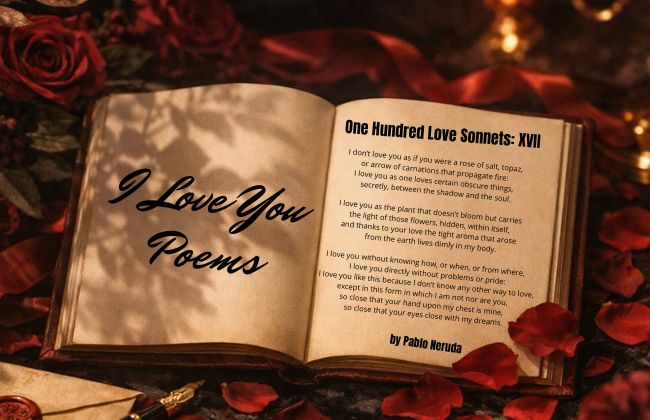
1. One Hundred Love Sonnets: XVII by Pablo Neruda
The poet rejects traditional romantic symbols like roses or fire, instead likening his love to hidden, enduring forces – “between the shadow and the soul.” This love is secretive, deeply rooted, and unexplainable, as Neruda admits he loves “without knowing how, or when, or from where.” The poem’s Petrarchan sonnet structure emphasizes this emotional journey, moving from attempts to define love to embracing its mystery.
Its most powerful idea is that love dissolves ego; by the end, the lovers are so spiritually close that “I” and “you” almost disappear into one shared existence.
I don’t love you as if you were a rose of salt, topaz,
or arrow of carnations that propagate fire:
I love you as one loves certain obscure things,
secretly, between the shadow and the soul.

I love you as the plant that doesn’t bloom but carries
the light of those flowers, hidden, within itself,
and thanks to your love the tight aroma that arose
from the earth lives dimly in my body.

I love you without knowing how, or when, or from where,
I love you directly without problems or pride:
I love you like this because I don’t know any other way to love,
except in this form in which I am not nor are you,
so close that your hand upon my chest is mine,
so close that your eyes close with my dreams.
2. How Do I Love Thee? (Sonnet 43) by Elizabeth Barrett Browning
How Do I Love Thee?” explores love as limitless, moral, spiritual, and enduring. Browning does not describe romance as mere passion; she measures it through the “depth and breadth and height” her soul can reach, suggesting a love that exceeds ordinary language and enters the realm of faith and identity.
The poem also moves from daily devotion to eternal commitment, showing love in both “quiet need” and the hope of loving “better after death.
How do I love thee? Let me count the ways.
I love thee to the depth and breadth and height
My soul can reach, when feeling out of sight
For the ends of being and ideal grace.
I love thee to the level of every day’s
Most quiet need, by sun and candle-light.
I love thee freely, as men strive for right.
I love thee purely, as they turn from praise.
I love thee with the passion put to use
In my old griefs, and with my childhood’s faith.
I love thee with a love I seemed to lose
With my lost saints. I love thee with the breath,
Smiles, tears, of all my life; and, if God choose,
I shall but love thee better after death.
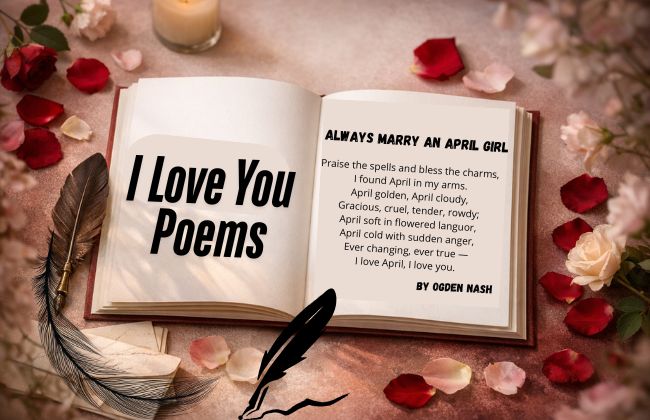
3. Always Marry An April Girl by Ogden Nash
Always Marry an April Girl” is a playful love poem that celebrates a partner whose beauty lies in her unpredictability. Nash compares the beloved to April weather – golden, cloudy, tender, cruel, soft, and suddenly angry – to suggest that real love embraces complexity rather than perfection.
The poem expresses affection for a person who changes constantly yet remains “ever true,” making emotional variety a sign of vitality, not instability.
Ultimately, Nash portrays love as a commitment to the dynamic essence of a partner, making their unpredictability a cherished blessing.
Praise the spells and bless the charms,
I found April in my arms.
April golden, April cloudy,
Gracious, cruel, tender, rowdy;
April soft in flowered languor,
April cold with sudden anger,
Ever changing, ever true —
I love April, I love you.
4. A Red, Red Rose by Robert Burns
A Red, Red Rose” is a love poem about admiration, devotion, and emotional permanence. Burns presents love as both beautiful and musical, comparing his beloved to a freshly blooming rose and a melody “sweetly played in tune,” which gives the poem tenderness and immediacy. The speaker is not only praising beauty; he is promising constancy.
His exaggerated vows—loving “till a’ the seas gang dry” and until “the rocks melt wi’ the sun”—show that the poem expresses love as timeless, absolute, and stronger than nature itself.
O my luve's like a red, red rose,
That's newly sprung in June;
O my luve's like the melodie
That's sweetly played in tune.
As fair art thou, my bonnie lass,
So deep in luve am I;
And I will luve thee still, my dear,
Till a' the seas gang dry.
Till a' the seas gang dry, my dear,
And the rocks melt wi' the sun:
O I will love thee still, my dear,
While the sands o' life shall run.
And fare thee weel, my only luve,
And fare thee weel awhile!
And I will come again, my luve,
Though it were ten thousand mile.
5. I Love You by Ella Wheeler Wilcox
Ella Wheeler Wilcox’s “I Love You” is not a quiet or idealized love poem; it celebrates desire as physical, mutual, and joyfully unapologetic. The speaker rejects “cold” or saintly affection and instead embraces passionate, embodied love—wine, kisses, warmth, youth, and closeness become symbols of a fully lived romance.
That makes the poem less about abstract devotion than about loving someone with both body and soul. The author seems to express a belief that real love should be vivid, fearless, and emotionally honest, even if the world judges it.
I love your lips when they’re wet with wine
And red with a wild desire;
I love your eyes when the lovelight lies
Lit with a passionate fire.
I love your arms when the warm white flesh
Touches mine in a fond embrace;
I love your hair when the strands enmesh
Your kisses against my face.

Not for me the cold, calm kiss
Of a virgin’s bloodless love;
Not for me the saint’s white bliss,
Nor the heart of a spotless dove.
But give me the love that so freely gives
And laughs at the whole world’s blame,
With your body so young and warm in my arms,
It sets my poor heart aflame.

So kiss me sweet with your warm wet mouth,
Still fragrant with ruby wine,
And say with a fervor born of the South
That your body and soul are mine.
Clasp me close in your warm young arms,
While the pale stars shine above,
And we’ll live our whole young lives away
In the joys of a living love.
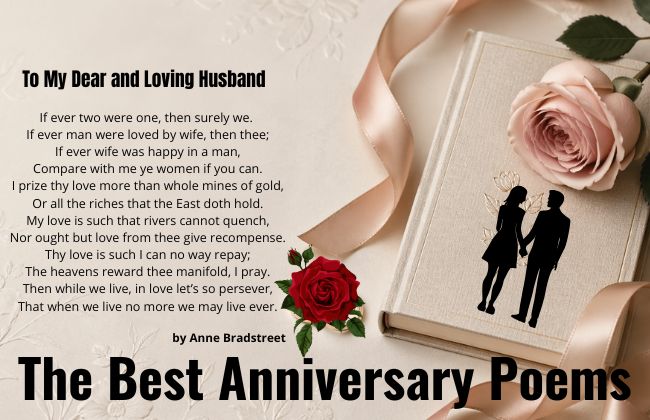
6. To My Dear and Loving Husband by Anne Bradstreet
To My Dear and Loving Husband” is a declaration of marital love expressed with unusual intensity, especially for a 17th-century Puritan poet.
Anne Bradstreet presents marriage as a complete spiritual and emotional union, opening with the famous claim that two lovers can become “one.” Rather than treating love as private sentiment alone, the poem elevates it above wealth, saying her husband’s love is worth more than “whole mines of gold.”
The author seems to express gratitude, devotion, and a belief that true love joins earthly happiness with eternal hope.
If ever two were one, then surely we.
If ever man were loved by wife, then thee;
If ever wife was happy in a man,
Compare with me ye women if you can.
I prize thy love more than whole mines of gold,
Or all the riches that the East doth hold.
My love is such that rivers cannot quench,
Nor ought but love from thee give recompense.
Thy love is such I can no way repay;
The heavens reward thee manifold, I pray.
Then while we live, in love let’s so persever,
That when we live no more we may live ever.
7. When You Are Old by W. B. Yeats
When You Are Old” is a poem about remembered love, regret, and the difference between surface admiration and deep emotional devotion. Yeats imagines a future in which the woman he addresses looks back on her youth and realizes that many loved her beauty, but only one person loved her “pilgrim soul” and the sorrows written into her changing face.
The poem expresses not triumphant romance but tender melancholy: love here is sincere, enduring, and haunted by possible loss.
When you are old and grey and full of sleep,
And nodding by the fire, take down this book,
And slowly read, and dream of the soft look
Your eyes had once, and of their shadows deep;

How many loved your moments of glad grace,
And loved your beauty with love false or true,
But one man loved the pilgrim soul in you,
And loved the sorrows of your changing face;

And bending down beside the glowing bars,
Murmur, a little sadly, how Love fled
And paced upon the mountains overhead
And hid his face amid a crowd of stars.
8. The Passionate Shepherd to His Love by Christopher Marlowe
Christopher Marlowe’s “The Passionate Shepherd to His Love” is a quintessential pastoral poem that idealizes rural life and romantic love. The speaker, a shepherd, invites his beloved to join him in a utopian countryside filled with natural beauty and sensual pleasures. He promises gifts like beds of roses, woolen gowns, and golden-buckled slippers, painting an idyllic vision of love free from responsibilities or hardships.
The poem celebrates the simplicity and harmony of nature while embracing the fleeting joys of youth and beauty.
Come live with me and be my love,
And we will all the pleasures prove,
That Valleys, groves, hills, and fields,
Woods, or steepy mountain yields.

And we will sit upon the Rocks,
Seeing the Shepherds feed their flocks,
By shallow Rivers to whose falls
Melodious birds sing Madrigals.

And I will make thee beds of Roses
And a thousand fragrant posies,
A cap of flowers, and a kirtle
Embroidered all with leaves of Myrtle;

A gown made of the finest wool
Which from our pretty Lambs we pull;
Fair lined slippers for the cold,
With buckles of the purest gold;

A belt of straw and Ivy buds,
With Coral clasps and Amber studs:
And if these pleasures may thee move,
Come live with me, and be my love.

The Shepherds’ Swains shall dance and sing
For thy delight each May-morning:
If these delights thy mind may move,
Then live with me, and be my love.
9. Dulzura by Sandra Cisneros
Sandra Cisneros’ “Dulzura” is a deeply intimate poem exploring love, identity, and cultural connection. The speaker yearns for a love expressed in Spanish; a language tied to her heritage and soul.
Through vivid imagery, such as “the sweet meat of the mango” and “the harp of my wrists,” Cisneros conveys a sensual and emotional longing for authenticity and understanding. The poem emphasizes the importance of being loved in a way that honors one’s cultural and linguistic identity.
By asking her lover to say her name “the way it’s supposed to be said,” the speaker seeks affirmation and recognition of her true self.
Make love to me in Spanish.
Not with that other tongue.
I want you juntito a mí,
tender like the language
crooned to babies.
I want to be that
lullabied, mi bien
querido, that loved.

I want you inside
the mouth of my heart,
inside the harp of my wrists,
the sweet meat of the mango,
in the gold that dangles
from my ears and neck.

Say my name. Say it.
The way it’s supposed to be said.
I want to know that I knew you
even before I knew you.
10. I Am Not Yours by Sara Teasdale
Sara Teasdale’s “I Am Not Yours” explores the tension between love and individuality. The speaker yearns for a love so profound it consumes her, yet she resists losing her identity.
Through vivid imagery, like a “candle lit at noon” and a “snowflake in the sea,” Teasdale conveys the desire for emotional immersion while maintaining autonomy.
The poem celebrates love’s intensity but challenges traditional notions of self-sacrifice, emphasizing the importance of balance in relationships. Its lyrical beauty and universal themes make it a timeless reflection on the complexities of intimacy and selfhood.
I am not yours, not lost in you,
Not lost, although I long to be
Lost as a candle lit at noon,
Lost as a snowflake in the sea.

You love me, and I find you still
A spirit beautiful and bright,
Yet I am I, who long to be
Lost as a light is lost in light.

Oh plunge me deep in love—put out
My senses, leave me deaf and blind,
Swept by the tempest of your love,
A taper in a rushing wind.
Common Themes in “I Love You” Poems
Most love poems revolve around a handful of universal emotions. Spotting these helps you understand (and enjoy) any poem faster:
- Passionate/Romantic Love: Poems driven by intense desire and longing, often using vivid nature imagery like fire, oceans, and storms to express overwhelming feeling. Neruda’s Twenty Love Poems and a Song of Despair is the defining example.
- Eternal / Undying Love: The promise that love will outlast time, distance, and even death. Burns’ A Red, Red Rose and Browning’s Sonnet 43 both make this vow directly.
- Unrequited Love: The ache of loving someone who does not love you back — one of poetry’s oldest and most universal subjects. Yeats’ When You Are Old and Chaucer’s Rondel of Merciless Beauty are classic examples.
- Consummate Love: A deep, mature bond that is emotional, intellectual, and spiritual — not just physical passion. Browning’s work is often cited as the gold standard of this theme.
- Love and Loss / Grief: Poems that mourn a lost love or a dead beloved, such as Poe’s Annabel Lee, explore how love and grief are inseparable.
- Platonic and Universal Love: Walt Whitman’s Song of Myself explores love as a connection among all humanity, transcending individual romantic relationships.
Common Poetic Styles and Forms
The way a love poem is built – its form and structure – shapes how the emotion is felt by the reader.
The Sonnet
The sonnet is the most iconic form in love poetry. It consists of 14 lines and was popularized in the Italian tradition by Petrarch in the 1300s before being mastered in English by Shakespeare and Browning.
Sonnets are divided into two main types:
- Petrarchan (Italian) Sonnet: An 8-line octave poses a question or problem; a 6-line sestet resolves it. Browning’s Sonnet 43 uses this form.
- Shakespearean Sonnet: Three 4-line quatrains develop the theme, ending in a powerful 2-line couplet that delivers a final twist or conclusion.
The compact, disciplined structure of the sonnet forces every word to count, making it uniquely suited to the intensity of love.
The Ode
An ode is a poem of direct address – it speaks to someone or something with sustained, elevated attention. Odes linger on their subject from multiple angles, praising, questioning, and learning from the beloved.
Their structure is flexible (regular or irregular stanzas), but their rhetorical motion is always one of deep, sustained admiration.
Free Verse
Free verse has no fixed meter or rhyme scheme – its structure is built from deliberate choices about line breaks, pacing, repetition, and visual layout on the page. Neruda’s love poetry is often written in free verse, which allows him to follow the natural rhythms of intense emotion rather than fitting feeling into a rigid template.
Free verse can feel like a spoken confession, which is part of why it resonates so powerfully in love poetry.
Lyric Poetry
Most love poems are a form of lyric poetry – short, personal, and focused on expressing subjective emotion rather than telling a story. The “I” of a lyric poem speaks directly from the heart, making the reader feel they are overhearing something deeply private.
You might also like: