Some poems don’t comfort you, they challenge you. Advice to Women by Eunice de Souza is exactly that kind of poem: short, sharp, and impossible to forget.
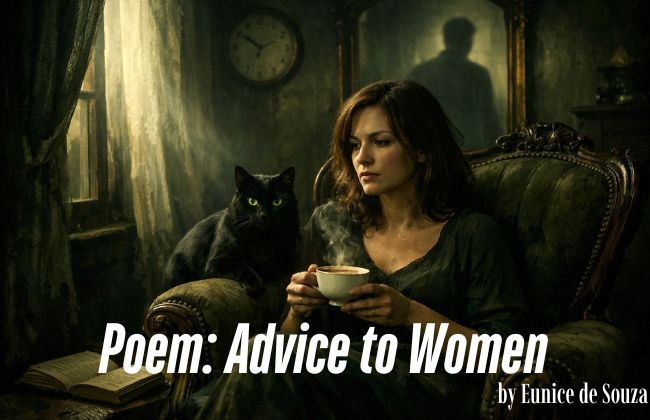
Written by one of India’s most celebrated English-language poets, this 12-line masterpiece uses the simple image of keeping cats to deliver a bold, unsentimental truth about love, independence, and the emotional distance that so often defines romantic relationships.
Whether you’re a student, a literature lover, or simply someone who has ever felt the “otherness” of a partner, this poem speaks to a deeply human experience with striking clarity and courage.
Ready to explore the depths of this remarkable poem? Read on to discover our complete analysis of “Advice To Women” and uncover the literary techniques and cultural insights that make this work so enduring.
Summary of “Advice to Women”
Eunice de Souza’s poem “Advice to Women” offers a unique perspective on relationships, independence, and emotional resilience. The speaker advises women to keep cats as a way to understand and cope with the emotional detachment often experienced in romantic relationships.
The cat, with its aloof and self-sufficient nature, becomes a metaphor for the “otherness” of lovers. The poem suggests that women should embrace independence, avoid emotional dependency, and prepare for the possibility of solitude.
Structure and Form
| Feature | Detail |
| Form | Free verse — no fixed rhyme scheme or meter |
| Length | 12 lines |
| Tone | Direct, unsentimental, conversational, sardonic |
| Point of View | Third-person speaker addressing women |
| Publication | Selected and New Poems, 1994 |
De Souza’s structural choices are deliberate and loaded with meaning:
- Free verse mirrors the freedom and independence the poet advocates for women — there are no constraints, no rigid rules.
- End-stopped lines give each piece of advice a crisp, declarative weight, as though each line is a maxim to be memorized.
- Short and long lines in alternation create an artistic rhythm that mimics the unpredictability of relationships themselves.
- The absence of sentimentality in the language reinforces the poem’s core message: emotional detachment is not a wound, it is a skill to be cultivated.
The poem reads like a series of pithy, epigrammatic statements rather than lyrical verse – intentionally cold, just like the behavior it describes.
Themes in Advice to Women
The “Otherness” of Lovers
The central theme of the poem is the concept of “otherness” – the emotional and psychological distance that men create within relationships.
De Souza does not portray this as mere cruelty; she presents it as an inherent characteristic of certain partners, one that women must learn to recognize and accept rather than fight against. The word “otherness” suggests not just indifference but a fundamental separateness – a reminder that no romantic partner can fully belong to another person.
Emotional Independence and Self-Reliance
Throughout the poem, de Souza advocates for emotional self-sufficiency. The advice to “keep cats” is fundamentally advice to practice not needing someone unconditionally.
Women are urged not to get entangled in the private battles of their lovers (“Don’t cuss out of the window at their enemies”), preserving their own dignity and energy.
Feminist Critique of Patriarchal Relationships
De Souza implicitly critiques a society that conditions women to tolerate emotional neglect and dependency.
By comparing men to cats — animals that return only to fulfill physical needs – she satirizes the transactional nature of how many men approach relationships. This is not a poem that consoles; it is one that challenges women to see their situation clearly.
Solitude as Strength
The poem’s ending – “to die alone” – is perhaps its most radical statement. Rather than presenting solitude as a failure, de Souza reframes it as the ultimate lesson a woman can learn: that independence, even in death, is not a defeat but a form of liberation.
The phrase strips away the fear of loneliness that society uses to keep women in unfulfilling relationships.
Physicality vs. Genuine Connection
The metaphor of the cat returning to its “litter tray” is a pointed commentary on the physical, rather than emotional, basis of many relationships. “Litter tray” – a place cats use for bodily needs — is a deliberately unglamorous comparison to a woman’s body, suggesting that some partners view women primarily as vessels for physical gratification.
Literary Devices
De Souza employs a compact but powerful set of literary devices in just 12 lines:
Metaphor
The poem’s most powerful device. Cats are a sustained metaphor for selfish, self-serving lovers. The “litter tray” metaphorically represents a woman’s body – the place a man returns to only when he needs something physical, not emotional. This comparison is deliberately blunt and reductive, mirroring how some men reduce women to utility.
Enjambment
De Souza uses enjambment (carrying a sentence across a line break without punctuation) to create suspense and forward momentum. The opening three lines flow into each other, pulling the reader into the argument before the full picture is revealed.
Assonance
The phrase “otherness of lovers” uses the repeated “o” sound to create an almost mournful internal echo — the word “otherness” itself sounds like “loneliness” in disguise.
Imagery
The “great green eyes” of a cat in perpetual surprise is one of the poem’s most haunting images. The color green traditionally symbolizes renewal and new life, here ironically pointing to the man’s excitement about a new relationship — while the woman is left behind.
Epigram
The entire poem functions as an epigram – a short, witty, and memorable statement of truth. Lines like “Otherness is not always neglect” stand alone as aphorisms about love and human nature.
Direct Address (Apostrophe)
By speaking directly to “women” in imperatives (“Keep,” “Don’t cuss”), de Souza creates a sense of urgent, personal counsel — as if the speaker is grabbing a friend by the shoulders.
Line-by-Line Analysis & Explanation
Lines 1–3: The Opening Command
Keep cats
if you want to learn to cope with
the otherness of lovers.
The poem opens with a stark imperative: “Keep cats.” There is no warm introduction, no gentle lead-in. The harsh “k” sound itself feels sharp and instructive. De Souza immediately positions the speaker as someone who has moved past comfort-seeking into hard-won clarity.
The word “cope” is critical – de Souza does not say “understand” or “overcome.” She uses “cope,” which implies the pain is real, ongoing, and manageable only through adaptation, not elimination. The phrase “otherness of lovers” introduces the poem’s key concept: the inevitable emotional foreignness that exists even within intimate relationships. A lover’s “otherness” is their fundamental separateness – the part of them that belongs to themselves, or to someone else entirely.
Lines 4–6: The Ironic Reassurance
Otherness is not always neglect –
Cats return to their litter trays
when they need to.
These lines deliver one of the poem’s sharpest ironies. The dash after “neglect” signals a pivot – what follows seems, on the surface, to be comfort: he does come back. But the metaphor immediately reveals the sinister truth: he comes back “when he needs to” — not because he misses you, not out of love, but out of physical necessity.
The “litter tray” is a deliberately unglamorous symbol. It is not a warm hearth or a beloved home – it is a place of bodily need. This comparison places the woman in a deeply objectifying context, making the “reassurance” of lines 4–6 feel more insulting than comforting.
Lines 7–8: A Warning Against Futile Loyalty
Don’t cuss out of the window
at their enemies.
The speaker now warns women against a specific form of self-destructive behavior: defending their lovers’ honor against rivals. The image of cursing out of a window is vivid and tragicomic – a woman shouting into the street on behalf of a man who has already moved on.
De Souza’s point is clear: your loyalty is not reciprocated, and performing it only humiliates you further. The “enemies” here could refer to a new lover, a rival, or anyone in the man’s orbit — the point is that these battles are no longer yours to fight.
Lines 9–12: The Final Revelation
That stare of perpetual surprise
in those great green eyes
will teach you
to die alone.
The poem’s closing image is its most powerful. The cat’s wide, perpetually surprised eyes – incapable of guilt, empathy, or recognition – represent the emotional blankness of men who have moved on. The word “perpetual” is crucial: this is not a momentary coldness but a permanent state of detachment.
The green eyes carry layered symbolism: green as the color of renewal and new beginnings points to the man’s excitement for fresh relationships; green as the color of envy quietly implicates the woman’s position; and green as a “cold” color underscores the emotional vacancy of the gaze.
The conclusion – “to die alone” – is the poem’s most radical and debated line. De Souza does not present this as doom but as enlightenment. A woman who has truly absorbed the lesson of the cat’s cold stare understands that clinging to indifferent love is more painful than solitude, and that dying alone is not failure – it is the ultimate form of self-possession.
FAQs
The poem advises women to embrace emotional independence and self-reliance in relationships. By observing the behavior of cats, which are independent and aloof, women can learn to cope with the emotional detachment or “otherness” often experienced in romantic relationships.
Cats symbolize independence, detachment, and self-sufficiency. They are not overly dependent on their owners, much like how the poet suggests women should not rely entirely on their romantic partners for emotional fulfillment. The metaphor of the cat helps illustrate the idea of maintaining individuality and resilience in relationships.
The “otherness of lovers” refers to the emotional distance or individuality that romantic partners often maintain. It highlights the idea that lovers may not always meet emotional expectations or fully share their inner lives, creating a sense of separation or detachment in relationships.
The tone of the poem is dryly humorous, pragmatic, and slightly satirical. Eunice de Souza uses a matter-of-fact approach to address the complexities of love and relationships, offering advice that is both practical and thought-provoking.
The final line serves as a stark reminder of mortality and the inevitability of solitude. It suggests that women should prepare themselves emotionally for the possibility of being alone, framing it as a natural and acceptable outcome rather than something to fear or avoid.
You might also like: