Veterans Day is a profound moment in our nation’s calendar—a time when we pause to honor the brave men and women who have worn the uniform in service to our country.

While parades, ceremonies, and moments of silence mark this important day, poetry offers us a unique and powerful way to express our gratitude and reflect on the sacrifices made by our veterans.
Throughout history, poets have captured the courage, sacrifice, and resilience of those who have served. From the trenches of World War I to modern-day deployments, verse has given voice to experiences that often transcend ordinary language.
These poems remind us that behind every uniform is a person—a son, daughter, parent, or friend—who answered the call to protect our freedoms.
We invite you to explore a collection of moving Veterans Day poems that beautifully articulate the honor and gratitude we feel for our nation’s heroes.
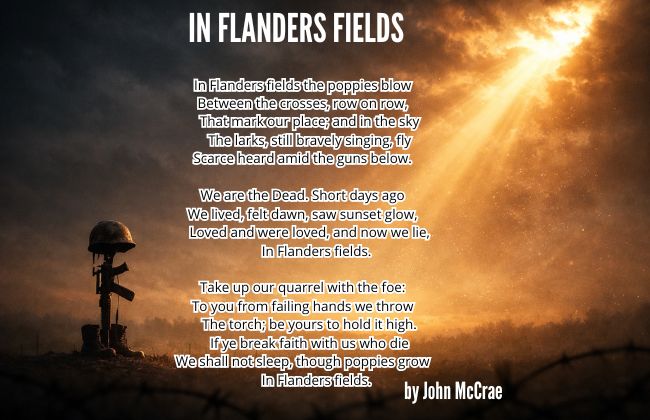
In Flanders Fields by John McCrae
Written in May 1915 during the Second Battle of Ypres, after the death of his friend Lieutenant Alexis Helmer, the poem transforms a battlefield cemetery into a voice for the fallen. McCrae contrasts poppies, birdsong, and open skies with guns and graves to show how beauty survives beside horror.
The central message is remembrance: the dead ask the living not to forget their sacrifice. At the same time, the poem expresses grief, patriotism, and wartime resolve, urging survivors to continue the struggle.
In Flanders fields the poppies blow
Between the crosses, row on row,
    That mark our place; and in the sky
    The larks, still bravely singing, fly
Scarce heard amid the guns below.

We are the Dead. Short days ago
We lived, felt dawn, saw sunset glow,
    Loved and were loved, and now we lie,
        In Flanders fields.

Take up our quarrel with the foe:
To you from failing hands we throw
    The torch; be yours to hold it high.
    If ye break faith with us who die
We shall not sleep, though poppies grow
        In Flanders fields.
Field Manoevures by Richard Aldington
Richard Aldington’s “Field Manoeuvres” is a poignant reflection on the tension between the natural world and the artificiality of war. Set during a military exercise, the poem vividly captures the sensory details of the environment—damp grass, pine scents, and the quiet hum of nature.
Aldington contrasts this serene imagery with the soldier’s duty, symbolized by an untouched rifle loaded with blanks.
The speaker’s mind drifts to a vision of beauty and peace, longing for nature’s tranquility amidst the rigidity of military life. As part of the Imagist movement, Aldington’s precise and evocative language underscores the human yearning for harmony, critiquing the unnaturalness of war while celebrating the enduring allure of the natural world.
The long autumn grass beneath my body
Soaks my clothes in dew;
Where my knees press into the ground
I can feel the damp earth.

In my nostrils is a smell of crushed grass,
Wet pine-cones and bark.

Through the bronze pine trunks
Glitters a silver segment of road.

Interminable squadrons of silver and grey horses
Pace in long ranks the blank fields of heaven.

There is no sound;
The wind hisses gently through the pine-needles;
The flutter of a finch’s wings about my head
Is violent as distant thunder,
And the shrill flight of a gnat
Sounds loud and clear.

I am “to fire at the enemy column
After it has passed”—
But my rifle (loaded with “blank”)
Lies untouched before me,
My spirit follows the gliding clouds
And my lips murmur of the mother of beauty
Standing breast-high in golden broom
Among the English pine-woods!
Not to Keep by Robert Frost
Robert Frost’s “Not to Keep” explores the emotional toll of war on both soldiers and their loved ones. The poem portrays a soldier’s temporary return home, emphasizing the bittersweet nature of his presence. While alive and seemingly unharmed, his return is fleeting, as he is destined to return to the battlefield.
Frost contrasts the wife’s initial relief with her growing dread, as she realizes her husband’s recovery only prepares him for further suffering.
The title underscores the impermanence of their reunion, reflecting the cruel reality of war.
Through simple language and halting rhythm, Frost captures the raw, unspoken pain of separation and the resilience required to endure repeated loss.
They sent him back to her. The letter came
Saying . . . And she could have him. And before
She could be sure there was no hidden ill
Under the formal writing, he was there,
Living. They gave him back to her alive—
How else? They are not known to send the dead—
And not disfigured visibly. His face?
His hands? She had to look, and ask,
‘What was it, dear?’ And she had given all
And still she had all—they had—they the lucky!
Wasn’t she glad now? Everything seemed won,
And all the rest for them permissible ease.
She had to ask, ‘What was it, dear?’

                                                                 ‘Enough
Yet not enough. A bullet through and through,
High in the breast. Nothing but what good care
And medicine and rest, and you a week,
Can cure me of to go again.’ The same
Grim giving to do over for them both.
She dared no more than ask him with her eyes
How was it with him for a second trial.
And with his eyes he asked her not to ask.
They had given him back to her, but not to keep.
Inscription by Herman Melville
– For Graves at Pea Ridge, Arkansas!
Herman Melville’s “Inscription for Graves at Pea Ridge, Arkansas” is a compact memorial poem that honors Union soldiers while justifying their sacrifice.
Their message is moral as well as political: they fought not for bloodlust, but for a lawful cause tied to “Man and Right.” By calling war “furious” yet preferable to “tame surrender,” the poem expresses grief, resolve, and civic conviction at once.
The final word, “victorious,” matters because the Battle of Pea Ridge ended in a Union victory in March 1862.
Let none misgive we died amiss
  When here we strove in furious fight:
Furious it was; nathless was this
  Better than tranquil plight,
And tame surrender of the Cause
Hallowed by hearts and by the laws.
  We here who warred for Man and Right,
The choice of warring never laid with us.
  There we were ruled by the traitor's choice.
  Nor long we stood to trim and poise,
But marched and fell—victorious!
Dulce et Decorum Est by Wilfred Owen
Wilfred Owen’s “Dulce et Decorum Est” is a searing critique of the glorification of war. Written during World War I, the poem vividly portrays the physical and emotional toll on soldiers, describing their exhaustion, injuries, and the horrors of a gas attack.
Owen juxtaposes the brutal reality of war with the idealized notion of dying for one’s country, famously calling it “the old Lie.” Through graphic imagery and a haunting tone, he conveys the trauma of witnessing a comrade’s agonizing death and the lasting psychological scars.
The poem challenges the romanticized view of war, urging readers to confront its grim truths and reject the false heroism often propagated.
Bent double, like old beggars under sacks,
Knock-kneed, coughing like hags, we cursed through sludge,
Till on the haunting flares we turned our backs
And towards our distant rest began to trudge.
Men marched asleep. Many had lost their boots
But limped on, blood-shod. All went lame; all blind;
Drunk with fatigue; deaf even to the hoots
Of tired, outstripped Five-Nines that dropped behind.

Gas! Gas! Quick, boys!—An ecstasy of fumbling,
Fitting the clumsy helmets just in time;
But someone still was yelling out and stumbling
And flound'ring like a man in fire or lime...
Dim, through the misty panes and thick green light,
As under a green sea, I saw him drowning.

In all my dreams, before my helpless sight,
He plunges at me, guttering, choking, drowning.

If in some smothering dreams you too could pace
Behind the wagon that we flung him in,
And watch the white eyes writhing in his face,
His hanging face, like a devil's sick of sin;
If you could hear, at every jolt, the blood
Come gargling from the froth-corrupted lungs,
Obscene as cancer, bitter as the cud
Of vile, incurable sores on innocent tongues,—
My friend, you would not tell with such high zest
To children ardent for some desperate glory,
The old Lie: Dulce et decorum est
Pro patria mori.
Prelude: The Troops by Siegfried Sassoon
The poem opens with a bleak dawn, symbolizing the relentless cycle of despair and endurance. Sassoon portrays the soldiers as haggard and resigned, yet clinging to life with stubborn resilience.
They march from safety into a desolate landscape of “smoking horizons” and “reeking woods,” where death is omnipresent. The poem mourns the loss of youth and vitality, describing the soldiers as an “unreturning army” who endure unimaginable suffering.
Dim, gradual thinning of the shapeless gloom
Shudders to drizzling daybreak that reveals
Disconsolate men who stamp their sodden boots
And turn dulled, sunken faces to the sky
Haggard and hopeless. They, who have beaten down
The stale despair of night, must now renew
Their desolation in the truce of dawn,
Murdering the livid hours that grope for peace.

Yet these, who cling to life with stubborn hands,
Can grin through storms of death and find a gap
In the clawed, cruel tangles of his defence.
They march from safety, and the bird-sung joy
Of grass-green thickets, to the land where all
Is ruin, and nothing blossoms but the sky
That hastens over them where they endure
Sad, smoking, flat horizons, reeking woods,
And foundered trench-lines volleying doom for doom.

O my brave brown companions, when your souls
Flock silently away, and the eyeless dead
Shame the wild beast of battle on the ridge,
Death will stand grieving in that field of war
Since your unvanquished hardihood is spent.
And through some mooned Valhalla there will pass
Battalions and battalions, scarred from hell;
The unreturning army that was youth;
The legions who have suffered and are dust.
Soldier: Twentieth Century by Isaac Rosenberg
The poem addresses a “great new Titan,” symbolizing the collective suffering and transformation of soldiers. Rosenberg contrasts historical figures like Napoleon and Caesar, whose power emerged from conquest, with the modern soldier, whose torment fuels a new, impersonal force.
The imagery of “unthinkable torture” and “eyes kissed by death” underscores the brutal realities of war, while the Titan’s growth suggests a shift from individual heroism to collective endurance.
Through free verse and mythic allusions, Rosenberg explores the soldier’s role as both victim and catalyst for societal upheaval, reflecting the disillusionment and existential questioning of the World War I era.
I love you, great new Titan!
Am I not you?
Napoleon and Caesar
Out of you grew.

Out of unthinkable torture,
Eyes kissed by death,
Won back to the world again,
Lost and won in a breath,

Cruel men are made immortal.
Out of your pain born,
They have stolen the sun's power
With their feet on your shoulders worn.

Let them shrink from your girth,
That has outgrown the pallid days
When you slept like Circe's swine
Or a word in the brain's ways.
The Role of Poetry in Honoring Veterans
Poetry plays a vital role in paying tribute to military service members by giving voice to emotions that are often difficult to express. A well-crafted poem cuts through noise and speaks directly to the heart. It provides a shared space for reflection, healing, and community support.
Here is why poetry remains a cornerstone of Veterans Day ceremonies:
- Preserves History: Poems document personal and collective experiences from different conflicts.
- Fosters Empathy: They help non-military citizens understand the unique challenges veterans face.
- Aids Healing: For many veterans, writing and reading poetry serves as a therapeutic tool to process trauma.
- Unites Communities: Public readings bring people together to mourn, celebrate, and reflect as one unified group.
Themes and Styles in Veterans Day Poetry
Veterans Day poetry spans a wide range of emotions and formats. You will find everything from traditional rhyming verses to modern free verse.
Regardless of the structure, several core themes frequently emerge:
- Sacrifice and Duty: Highlighting the immense personal costs of leaving home and facing danger.
- Camaraderie: Celebrating the unbreakable bonds formed between soldiers on the battlefield.
- Loss and Remembrance: Honoring those who did not return and the grief carried by those who did.
- Patriotism: Expressing a deep, unwavering love for the country and its values.
Styles vary greatly. Classic poems use strict meter and rhyme to create a solemn rhythm. Contemporary pieces often use free verse to deliver raw, unfiltered accounts of modern warfare, making the emotion the primary focus of the piece.
You might also like: