Spanish love poems have long enchanted readers with their passionate expressions, lyrical beauty, and profound emotions.

Rooted in centuries of rich literary tradition, these poems are celebrated for their ability to capture the intensity of love, longing, and desire in just a few carefully chosen words. From the golden verses of classical poets like Gustavo Adolfo Bécquer to the contemporary voices echoing through modern Spain and Latin America, Spanish love poetry offers a unique window into the heart and soul of a vibrant culture.
Each poem is a glimpse into a world where love is not just a feeling but an art form, celebrated and cherished through the power of words.
In this article, we will explore a selection of enchanting Spanish love poems, providing translations and analyses to deepen your appreciation.
Whether you’re a seasoned poetry lover or new to the genre, these verses will inspire and evoke feelings of affection, longing, and devotion.
Famous spanish love poems
1. Soneto XXIII by Garcilaso de la Vega
This Renaissance sonnet captures the fleeting beauty of youth and love, urging the beloved to seize the moment before time fades her radiance. Using vivid imagery of roses and lilies, Garcilaso idealizes the beloved’s beauty while reflecting on its transience, embodying the Petrarchan theme of carpe diem with a tender, melancholic tone.
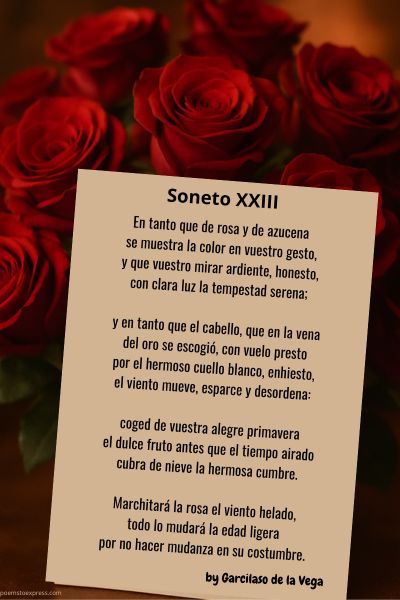
En tanto que de rosa y de azucena
se muestra la color en vuestro gesto,
y que vuestro mirar ardiente, honesto,
con clara luz la tempestad serena;

y en tanto que el cabello, que en la vena
del oro se escogió, con vuelo presto
por el hermoso cuello blanco, enhiesto,
el viento mueve, esparce y desordena:

coged de vuestra alegre primavera
el dulce fruto antes que el tiempo airado
cubra de nieve la hermosa cumbre.

Marchitará la rosa el viento helado,
todo lo mudará la edad ligera
por no hacer mudanza en su costumbre.
Sonnet XXIII (English Translation)

As long as rose and lily
the color is shown in your gesture,
and that your ardent, honest look,
ignites the heart and restrains it;

and while the hair, which in the vein
of gold was chosen, with swift flight,
by the beautiful white neck, upright,
the wind moves, spreads and messes up:

take from your happy spring
the sweet fruit, before the angry weather
cover the beautiful summit with snow;

The icy wind will wither the rose.
The light age will change everything
for not making a move in his custom.
2. Rima LIII by Gustavo Adolfo Bécquer
This Romantic poem uses the metaphor of swallows and flowers returning seasonally to express the pain of lost love. Bécquer conveys a melancholic longing for a past romance that will never return, capturing the fleeting nature of love and memory with simple yet haunting lyricism.
Volverán las oscuras golondrinas
en tu balcón sus nidos a colgar,
y otra vez con el ala a sus cristales
jugando llamarán.

Pero aquellas que el vuelo refrenaban
tu hermosura y mi dicha a contemplar,
aquellas que aprendieron nuestros nombres...
¡esas... no volverán!.

Volverán las tupidas madreselvas
de tu jardín las tapias a escalar,
y otra vez a la tarde aún más hermosas
sus flores se abrirán.

Pero aquellas, cuajadas de rocío
cuyas gotas mirábamos temblar
y caer como lágrimas del día...
¡esas... no volverán!

Volverán del amor en tus oídos
las palabras ardientes a sonar;
tu corazón de su profundo sueño
tal vez despertará.

Pero mudo y absorto y de rodillas
como se adora a Dios ante su altar,
como yo te he querido...; desengáñate,
¡así... no te querrán!
Rima LIII (English Translation)

The dark swallows will return
On your balcony their nests to hang
And, again, with the wing to its crystals
Playing they will call.

But those that the flight restrained
Your beauty and my happiness to contemplate,
Those who learned our names...
Those... won't come back!

The bushy honeysuckles will return
From your garden the walls to climb,
And again in the afternoon, even more beautiful,
Its flowers will open;

But those, curdled with dew,
Whose drops we watched tremble
And fall, like tears of the day...
Those... won't come back!

They will return from love in your ears
The burning words to sound;
Your heart from its deep sleep
Maybe he would wake up;

But mute and absorbed and kneeling,
As God is worshiped before his altar,
As I have loved you... disappoint yourself,
So they won't love you!
3. Amor, ahora nos vamos a la casa by Pablo Neruda
This poem by Pablo Neruda reflects the journey of love, comparing it to a nomadic adventure across the world. It expresses a longing for rest and belonging, as love finds its way back to a familiar, nurturing home.
The imagery of nature and travel symbolizes the depth and universality of love, ultimately emphasizing the need for grounding and connection after wandering.
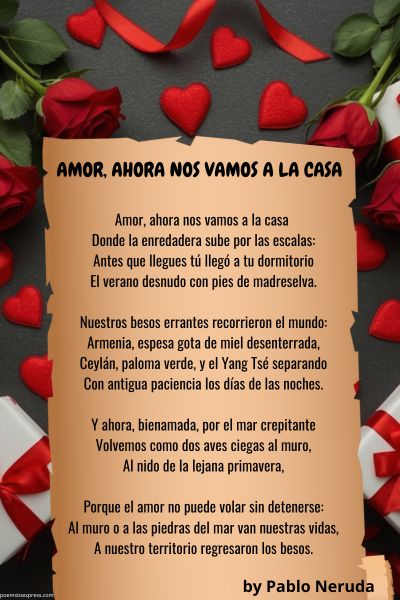
Amor, ahora nos vamos a la casa
Donde la enredadera sube por las escalas:
Antes que llegues tú llegó a tu dormitorio
El verano desnudo con pies de madreselva.

Nuestros besos errantes recorrieron el mundo:
Armenia, espesa gota de miel desenterrada,
Ceylán, paloma verde, y el Yang Tsé separando
Con antigua paciencia los días de las noches.

Y ahora, bienamada, por el mar crepitante
Volvemos como dos aves ciegas al muro,
Al nido de la lejana primavera,

Porque el amor no puede volar sin detenerse:
Al muro o a las piedras del mar van nuestras vidas,
A nuestro territorio regresaron los besos.
Love, We're Going Home Now (English Translation)

Love, we're going home now,
Where the vines clamber over the trellis:
Even before you, the summer will arrive,
On its honeysuckle feet, in your bedroom.

Our nomadic kisses wandered over all the world:
Armenia, dollop of disinterred honey:
Ceylon, green dove: and the YangTse with its old
Old patience, dividing the day from the night.

And now, dearest, we return, across the crackling sea
Like two blind birds to their wall,
To their nest in a distant spring:

Because love cannot always fly without resting,
Our lives return to the wall, to the rocks of the sea:
Our kisses head back home where they belong.
4. Amor constante más allá de la muerte by Francisco de Quevedo
Quevedo’s Baroque sonnet explores love’s endurance beyond death. With intense, philosophical imagery, it portrays a love so powerful that it persists in the soul even after the body’s dissolution, confronting mortality with defiant passion and metaphysical depth.
Cerrar podrá mis ojos la postrera
Sombra que me llevare el blanco día,
Y podrá desatar esta alma mía
Hora, a su afán ansioso lisonjera;

Mas no de esotra parte en la ribera
Dejará la memoria, en donde ardía:
Nadar sabe mi llama el agua fría,
Y perder el respeto a ley severa.

Alma, a quien todo un Dios prisión ha sido,
Venas, que humor a tanto fuego han dado,
Médulas, que han gloriosamente ardido,

Su cuerpo dejará, no su cuidado;
Serán ceniza, mas tendrá sentido;
Polvo serán, mas polvo enamorado.
Constant Love Beyond Death (English Translation)

The last shadow will close my eyes,
The white day will carry me away,
And it may untie this soul of mine,
At the hour, eager to please its anxious desire;
But not on the other side of the shore
Will the memory leave, where it once burned:
My flame knows how to swim in cold water,
And lose respect for strict law.
Soul, whom all of God has been a prison,
Veins that to such fire have given humors,
Marrows that have gloriously burned,
It will leave its body, but not its care;
They will be ashes, but still with meaning;
They will be dust, but dust in love.
5. El amor duerme en el pecho del poeta by Federico García Lorca
This poem by Federico García Lorca expresses a deep, unfulfilled longing and emotional torment. It conveys themes of unreciprocated love, inner conflict, and the pain of yearning for connection.
The imagery of sleep, blood, and violins symbolizes emotional distance, vulnerability, and sorrow, while the external world watches, intensifying the speaker’s anguish.
Tú nunca entenderás lo que te quiero
porque duermes en mí y estás dormido.
Yo te oculto llorando, perseguido
por una voz de penetrante acero.

Norma que agita igual carne y lucero
traspasa ya mi pecho dolorido
y las turbias palabras han mordido
las alas de tu espíritu severo.

Grupo de gente salta en los jardines
esperando tu cuerpo y mi agonía
en caballos de luz y verdes crines.

Pero sigue durmiendo, vida mía.
Oye mi sangre rota en los violines.
¡Mira que nos acechan todavía!
Love Sleeps in the Poet's Chest (English Translation)

You will never understand what I want from you
because you sleep within me and are asleep.
I hide you, crying, pursued
by a voice of penetrating steel.

A norm that stirs both flesh and star
pierces my aching chest,
and the murky words have bitten
the wings of your severe spirit.

A group of people jumps in the gardens,
waiting for your body and my agony
on horses of light and green manes.

But keep sleeping, my love.
Hear my blood broken in the violins.
See how they still watch us.
6. Me gusta cuando callas by Pablo Neruda
Neruda’s poem celebrates the quiet presence of the beloved, finding beauty in her silence. It expresses a serene, intimate love that transcends words, with lush imagery that captures the beloved’s essence as a source of peace and inspiration.
Me gustas cuando callas porque estás como ausente,
y me oyes desde lejos, y mi voz no te toca.
Parece que los ojos se te hubieran volado
y parece que un beso te cerrara la boca.

Como todas las cosas están llenas de mi alma
emerges de las cosas, llena del alma mía.
Mariposa de sueño, te pareces a mi alma,
y te pareces a la palabra melancolía.

Me gustas cuando callas y estás como distante.
Y estás como quejándote, mariposa en arrullo.
Y me oyes desde lejos, y mi voz no te alcanza:
déjame que me calle con el silencio tuyo.

Déjame que te hable también con tu silencio
claro como una lámpara, simple como un anillo.
Eres como la noche, callada y constelada.
Tu silencio es de estrella, tan lejano y sencillo.

Me gustas cuando callas porque estás como ausente.
Distante y dolorosa como si hubieras muerto.
Una palabra entonces, una sonrisa bastan.
Y estoy alegre, alegre de que no sea cierto.
I Like It When You Are Silent (English Translation)

I like it when you are silent because you are like absent,
and you hear me from afar, and my voice doesn't touch you.
It seems that your eyes have flown away
and it seems that a kiss has closed your mouth.

Like all things are filled with my soul
you emerge from them, full of my soul.
Butterfly of dream, you resemble my soul,
and you resemble the word melancholy.

I like it when you are silent and you are like distant.
And you are like complaining, butterfly in a lull.
And you hear me from afar, and my voice doesn't reach you:
let me be silent with your silence.

Let me speak to you also with your silence,
clear as a lamp, simple as a ring.
You are like the night, silent and starred.
Your silence is like a star, so distant and simple.

I like it when you are silent because you are like absent.
Distant and painful like you had died.
Then one word, a smile is enough.
And I am happy, happy that it isn't true.
7. El poeta pide a su amor que le escriba by Federico García Lorca
The poem expresses the anguish of unrequited love and the longing for connection. The poet pleads for written words from their beloved, symbolizing emotional validation. It contrasts eternal elements like air and stone with the fleeting pain of love, portraying a struggle between passion and despair.
Ultimately, it reflects a choice between the torment of unfulfilled love or retreating into eternal solitude.
Amor de mis entrañas, viva muerte,
en vano espero tu palabra escrita
y pienso, con la flor que se marchita,
que si vivo sin mí quiero perderte.

El aire es inmortal. La piedra inerte
ni conoce la sombra ni la evita.
Corazón interior no necesita
la miel helada que la luna vierte.

Pero yo te sufrí. Rasgué mis venas,
tigre y paloma, sobre tu cintura
en duelo de mordiscos y azucenas.

Llena, pues, de palabras mi locura
o déjame vivir en mi serena
noche del alma para siempre oscura.
The Poet Asks His Love to Write to Him (English Translation)

Love of my entrails, living death,
in vain I wait for your written word
and I think, with the flower that withers,
that if I live without me, I want to lose you.

The air is immortal. The stone inert
neither knows the shadow nor avoids it.
The inner heart does not need
the frozen honey that the moon pours.

But I suffered for you. I tore my veins,
tiger and dove, on your waist
in a duel of bites and lilies.

So fill my madness with words,
or let me live in my serene
night of the soul, forever dark.
8. Amor Eterno by Gustavo Adolfo Bécquer
The poem “Amor Eterno” by Gustavo Adolfo Bécquer expresses the eternal and unbreakable nature of love. It conveys that even if the world collapses or death arrives, the speaker’s love will remain undying and unextinguishable, transcending all physical and temporal boundaries.
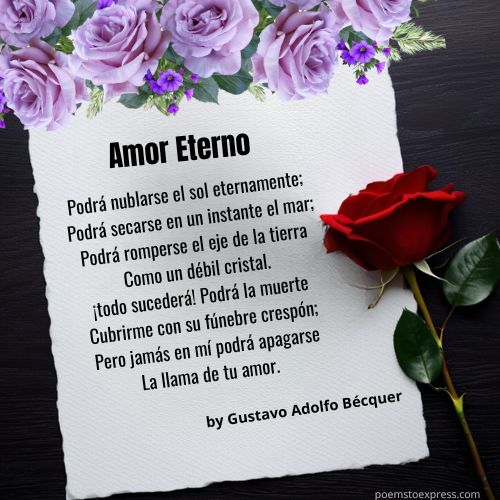
Podrá nublarse el sol eternamente;
Podrá secarse en un instante el mar;
Podrá romperse el eje de la tierra
Como un débil cristal.
¡todo sucederá! Podrá la muerte
Cubrirme con su fúnebre crespón;
Pero jamás en mí podrá apagarse
La llama de tu amor.
Eternal Love (English Translation)

The face of the sun may darken forever,
The oceans run dry in an instant of fire.
The axis spinning our planet may shatter
Like so much brittle crystal.
Yes, all of that may happen! At the end, Death
May cover my flesh with her funeral shroud;
But none of it will reach within my soul and snuff
The bright flame of your love.
9. El enamorado by Jorge Luis Borges
The poem expresses the idea that everything in the world—history, art, and reality itself—feels insignificant or illusory compared to the overwhelming presence of the beloved.
The speaker’s entire existence is consumed by their love, which is both their joy and their suffering, pure and infinite. It reflects the transformative and all-encompassing nature of love.
Lunas, marfiles, instrumentos, rosas,
lámparas y la línea de Durero,
las nueve cifras y el cambiante cero,
debo fingir que existen esas cosas.

Debo fingir que en el pasado fueron
Persépolis y Roma y que una arena
sutil midió la suerte de la almena
que los siglos de hierro deshicieron.

Debo fingir las armas y la pira
de la epopeya y los pesados mares
que roen de la tierra los pilares.

Debo fingir que hay otros. Es mentira.
Sólo tú eres. Tú, mi desventura
y mi ventura, inagotable y pura.
The Lover (English Translation)

Moons, ivories, instruments, roses,
lamps and the line of Dürer,
the nine figures and the changing zero,
I must pretend that these things exist.

I must pretend that in the past there were
Persepolis and Rome, and that a subtle sand
measured the fortune of the battlement
that the centuries of iron undid.

I must pretend the weapons and the pyre
of the epic and the heavy seas
that gnaw at the pillars of the earth.

I must pretend that there are others. It’s a lie.
Only you are. You, my misfortune
and my fortune, inexhaustible and pure.
10. Dame La Mano by Gabriela Mistral
The poem expresses unity, love, and harmony through the metaphor of dance. It symbolizes two individuals merging into one, transcending their identities to become a shared experience of beauty and simplicity.
The imagery of flowers and wheat conveys natural, effortless connection, while the repetition of “y nada más” emphasizes the purity and singularity of their bond.
Dame la mano y danzaremos;
dame la mano y me amarás.
Como una sola flor seremos,
como una flor, y nada más.

El mismo verso cantaremos,
al mismo paso bailarás.
Como una espiga ondularemos,
como una espiga, y nada más.

Te llamas Rosa y yo Esperanza;
pero tu nombre olvidarás,
porque seremos una danza
en la colina y nada más.
Give Me Your Hand (English Translation)

Give me your hand and give me your love,
give me your hand and dance with me.
A single flower, and nothing more,
a single flower is all we'll be.

Keeping time in the dance together,
singing the tune together with me,
grass in the wind, and nothing more,
grass in the wind is all we'll be.

I'm called Hope and you're called Rose:
but losing our names we'll both go free,
a dance on the hills, and nothing more,
a dance on the hills is all we'll be.
Unique Characteristics of Spanish Love Poetry
Spanish love poetry is distinguished by several features that set it apart from other traditions:
- Emotional Intensity: Spanish poets often convey raw, visceral emotions, whether through the anguished longing of jarchas or the passionate outbursts of Romanticism.
- Interplay of Sacred and Profane: Many poems blur the line between human and divine love, as seen in mystical poetry or Quevedo’s meditations on eternal love.
- Rich Imagery and Metaphor: From Garcilaso’s pastoral landscapes to Lorca’s surreal symbols, Spanish love poetry employs vivid, often nature-inspired imagery.
- Musicality and Oral Roots: The influence of oral traditions like cantigas and ballads gives Spanish poetry a rhythmic, song-like quality, evident in Bécquer’s lyrical Rimas.
- Cultural Syncretism: Reflecting Spain’s history, love poetry incorporates Arabic, Jewish, and Christian elements, especially in medieval works.
- Formal Versatility: Spanish poets master various forms—sonnets, villancicos, free verse—adapting them to express love’s complexities.
Themes and Styles in Spanish Love Poetry
Spanish love poetry explores a range of themes and employs diverse styles, reflecting both universal and culturally specific perspectives.
Common Themes
Idealized Love:
- Rooted in courtly love, poets like Garcilaso idealize the beloved as unattainable, often comparing them to natural or divine beauty.
- Example: Garcilaso’s Sonnet V likens the beloved to a radiant star.
Unrequited Love and Longing:
- Many poems express unfulfilled desire, from jarchas to Bécquer’s melancholic Rimas, capturing love’s pain and transience.
Love and Death:
- Baroque poets like Quevedo and modern poets like Lorca intertwine love with mortality, exploring its endurance or futility.
- Example: Lorca’s Sonnets of Dark Love evoke tragic passion.
Nature as Metaphor:
- Nature—rivers, flowers, birds—symbolizes love’s beauty or fragility, as in cantigas or Bécquer’s swallow imagery.
Spiritual Love:
- Mystical poets equate romantic love with divine union, using sensual language to describe spiritual ecstasy.
Social and Political Contexts:
- Modern poets like Fuertes address gender roles, while Lorca’s work reflects Spain’s turbulent history.
Styles and Literary Movements
- Courtly Love (Medieval): Formal, idealized, with strict poetic structures.
- Petrarchan Sonnets (Renaissance): 14-line poems with intricate rhyme schemes, focusing on unrequited love.
- Baroque (Golden Age): Ornate (culteranismo) or witty (conceptismo), with complex metaphors.
- Romanticism: Emotional, lyrical, with simple language and existential themes.
- Modernism and Surrealism: Experimental, introspective, blending realism with dreamlike imagery.
- Contemporary: Free verse, addressing modern issues like identity and globalization.
You might also like: