Friendship is one of the most cherished and timeless themes in literature, capturing the essence of human connection, loyalty, and shared experiences.
Throughout history, poets have beautifully expressed the depth and nuances of friendship, creating verses that resonate across generations.
From the warmth of companionship to the bittersweet moments of parting, famous poems about friendship remind us why these bonds are so vital to our lives. Whether you’re seeking inspiration, comfort, or simply a celebration of your own friendships, poetry offers a unique window into the heart’s most sincere emotions.
In this post, we’ll explore some of the most iconic and beloved poems that honor friendship, showcasing the power of words to strengthen and celebrate these special relationships.
Poems about friendship by famous poets
A Friend Poem by Gillian Jones
The poem “A Friend” by Gillian Jones celebrates the essence of true friendship. It emphasizes the qualities of a genuine friend—someone who listens without judgment, supports during tough times, and shares joy in happy moments.
The poem uses a metaphor, comparing friendship to “pure gold,” symbolizing its priceless value.
Jones encourages readers to cherish and reciprocate friendship, highlighting its mutual and enduring nature. This timeless piece resonates with readers by reminding them of the importance of kindness, loyalty, and gratitude in friendships.
A person who will listen and not condemn
Someone on whom you can depend
They will not flee when bad times are here
Instead they will be there to lend an ear
They will think of ways to make you smile
So you can be happy for a while
When times are good and happy there after
They will be there to share the laughter
Do not forget your friends at all
For they pick you up when you fall
Do not expect to just take and hold
Give friendship back, it is pure gold.
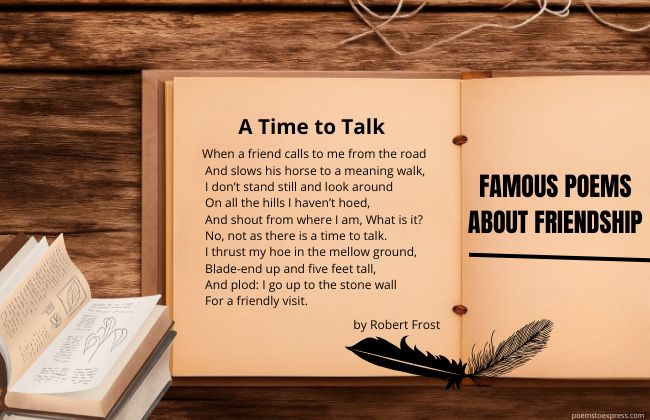
A Time to Talk by Robert Frost
The poem emphasizes the importance of pausing in the midst of daily tasks to connect with others.
The speaker, while working on the farm, is approached by a friend, and instead of continuing his labor, he decides to take a moment to talk. This simple act of setting aside work for a conversation highlights the value of human connection.
Frost conveys the idea that, no matter how busy life gets, moments spent with friends are precious and worth prioritizing. Through vivid imagery and a direct tone, the poem reminds us that relationships and conversations should not be neglected, even when there’s work to be done.
When a friend calls to me from the road
And slows his horse to a meaning walk,
I don’t stand still and look around
On all the hills I haven’t hoed,
And shout from where I am, What is it?
No, not as there is a time to talk.
I thrust my hoe in the mellow ground,
Blade-end up and five feet tall,
And plod: I go up to the stone wall
For a friendly visit.
Sonnet 104 by William Shakespeare
William Shakespeare’s Sonnet 104 explores the themes of beauty, time, and the inevitability of aging. Addressed to the Fair Youth, the speaker marvels at the youth’s seemingly unchanging beauty over three years, despite the passage of seasons.
However, the speaker acknowledges that time’s effects are subtle, likening them to the imperceptible movement of a clock’s hand.
The sonnet concludes with a poignant reflection: future generations will never witness the unparalleled beauty of the Fair Youth, as it will have faded with time.
To me, fair friend, you never can be old,
For as you were when first your eye I ey’d,
Such seems your beauty still. Three winters cold,
Have from the forests shook three summers’ pride,
Three beauteous springs to yellow autumn turn’d,
In process of the seasons have I seen,
Three April perfumes in three hot Junes burn’d,
Since first I saw you fresh, which yet are green.
Ah! yet doth beauty like a dial-hand,
Steal from his figure, and no pace perceiv’d;
So your sweet hue, which methinks still doth stand,
Hath motion, and mine eye may be deceiv’d:
    For fear of which, hear this thou age unbred:
    Ere you were born was beauty’s summer dead.
Friends For Life by Angelica N. Brisset
The poem emphasizes mutual support, loyalty, and emotional connection between friends. Through simple yet powerful lines, it conveys the promise of being there for each other during moments of joy and sorrow.
The poet highlights the importance of empathy, offering comfort during tears and mending broken hearts. The recurring theme of standing together, regardless of disagreements, underscores the enduring nature of true friendship.
With its rhythmic flow and relatable sentiments, the poem resonates deeply, reminding readers of the value of love, trust, and companionship in friendships that last a lifetime.
We are friends.
I've got your back,
And you have mine.
I'll help you out
Anytime!
To see you hurt,
To see you cry,
Makes me weep
And wanna die.
If you agree
To never fight,
It wouldn't matter
Who's wrong or right.
If a broken heart
Needs a mend,
I'll be right there
Till the end.
If your cheeks are wet
From drops of tears,
Don't worry,
Let go of your fears.
Hand in hand
Love is sent.
We'll be friends
Till the end!
Will You Ever? by Kaitlyn M. Yawn
Kaitlyn M. Yawn’s poem “Will You Ever?” is a heartfelt tribute to a cherished friend whose impact is profound yet often unrecognized.
The speaker expresses deep gratitude, highlighting how the friend has illuminated their darkest moments and provided unwavering support. Through vivid imagery, the poem conveys the transformative power of friendship, emphasizing the rarity of unconditional love and the completeness it brings to one’s life.
The recurring question, “Will you ever?” underscores the speaker’s wonder at whether the friend can truly grasp the depth of their influence.
I don't think you will
Ever fully understand
How you've touched my life
And made me who I am.

I don't think you could ever know
Just how truly special you are,
That even on the darkest nights
You are my brightest star.

You've allowed me to experience
Something very hard to find,
Unconditional love that exists
In my body, soul, and mind.

I don't think you could ever feel
All the love I have to give,
And I'm sure you'll never realize
You've been my will to live.

You are an amazing person,
And without you I don't know where I'd be.
Having you in my life
Completes and fulfills every part of me.
A poison tree by William Blake
The poem contrasts two scenarios: anger resolved through communication with a friend and anger nurtured in silence toward a foe.
The latter grows into a metaphorical tree, watered by fears and deceit, bearing a poisonous apple. This apple, symbolizing vengeance, lures the foe, leading to their demise. Blake uses vivid imagery and biblical allusions, such as the forbidden fruit, to emphasize the moral dangers of harboring resentment.
I was angry with my friend;
I told my wrath, my wrath did end.
I was angry with my foe:
I told it not, my wrath did grow.

And I waterd it in fears,
Night & morning with my tears:
And I sunned it with smiles,
And with soft deceitful wiles.

And it grew both day and night.
Till it bore an apple bright.
And my foe beheld it shine,
And he knew that it was mine.

And into my garden stole,
When the night had veild the pole;
In the morning glad I see;
My foe outstretched beneath the tree.
Friendship After Love by Ella Wheeler Wilcox
Ella Wheeler Wilcox’s Friendship After Love reflects on the emotional aftermath of a romantic relationship transitioning into friendship. Using vivid seasonal imagery, the poem compares the intensity of love to a blazing midsummer, which fades into the calm yet melancholic St. Martin days.
While the friendship that follows offers peace and freedom from the torment of love, it is tinged with a sense of incompleteness and loss. The poet captures the bittersweet reality of former lovers who, despite no longer desiring the pain of love, feel haunted by its absence.
This poignant piece explores themes of emotional evolution, longing, and the complexities of maintaining a connection after passion has subsided.
After the fierce midsummer all ablaze
    Has burned itself to ashes, and expires
    In the intensity of its own fires,
There come the mellow, mild, St. Martin days
Crowned with the calm of peace, but sad with haze.
    So after Love has led us, till he tires
    Of his own throes, and torments, and desires,
Comes large-eyed friendship: with a restful gaze,
He beckons us to follow, and across
    Cool verdant vales we wander free from care.
    Is it a touch of frost lies in the air?
Why are we haunted with a sense of loss?
We do not wish the pain back, or the heat;
And yet, and yet, these days are incomplete.
To All My Friends by May Yang
Through vivid imagery, Yang expresses gratitude for friends who have stood by her side during moments of weakness, anguish, and rage.
The poem emphasizes the importance of being seen, heard, and understood, even when the world remains silent. Yang’s use of sensory language—”breathing, looking, seeing, smelling”—conveys a deep appreciation for the present moment and the connections that ground us.
That I could be this human at this time
breathing, looking, seeing, smelling
That I could be this moment at this time
resting, calmly moving, feeling
That I could be this excellence at this time
sudden, changed, peaceful, & woke
To all my friends who have been with me in weakness
when water falls rush down my two sides
To all my friends who have felt me in anguish
when this earthen back breaks between the crack of two blades
To all my friends who have held me in rage
when fire tears through swallows behind tight grins
I know you
I see you
I hear you
Although the world is silent around you
I know you
I see you
I hear you
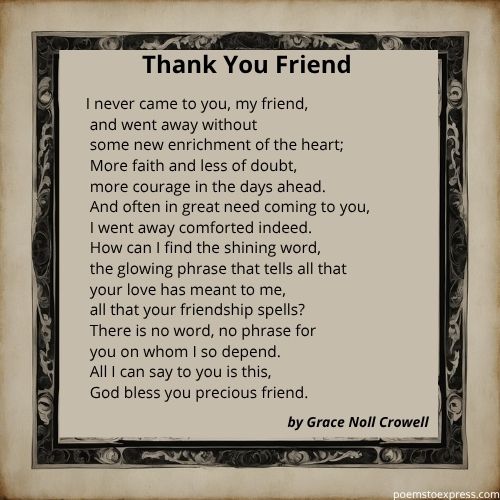
Thank You Friend by Grace Noll Crowell
The poem highlights the friend’s ability to provide comfort, courage, and faith during challenging times.
Through simple yet sincere language, the speaker acknowledges the invaluable support and love their friend has offered, describing it as beyond words or phrases.
The poem concludes with a blessing, emphasizing the deep appreciation and reliance on this cherished bond.
Crowell’s work resonates universally, celebrating the transformative power of friendship and its role in enriching the heart and soul.
I never came to you, my friend,
and went away without
some new enrichment of the heart;
More faith and less of doubt,
more courage in the days ahead.
And often in great need coming to you,
I went away comforted indeed.
How can I find the shining word,
the glowing phrase that tells all that
your love has meant to me,
all that your friendship spells?
There is no word, no phrase for
you on whom I so depend.
All I can say to you is this,
God bless you precious friend.
Key Messages and Symbolism in Friendship Poetry
Friendship poetry is rich in messages and symbolism, using various techniques to communicate the depth and importance of friendship.
Common Messages
- Loyalty and Trust: Many poems emphasize the steadfastness and reliability of true friends.
- Support in Adversity: Friendship is often portrayed as a source of comfort during difficult times.
- Celebration of Joy: Poems highlight shared happiness, laughter, and the beauty of companionship.
- Growth and Transformation: Some poems explore how friends help each other grow and change for the better.
Symbolism
Friendship poems frequently use symbols to represent the qualities of friendship, such as:
- Nature: Trees, rivers, and stars often symbolize the enduring and nurturing aspects of friendship.
- Journeys: The path or road is a common metaphor for the shared experiences and adventures of friends.
- Light: Candles, the sun, or stars may represent the guidance and hope that friends provide.
Common Themes in Friendship Poetry
Friendship poems often explore recurring themes that resonate across cultures and eras. These themes help readers connect with the poetry on a personal level.
1. Endurance Through Time
- Friendship is often portrayed as a bond that withstands challenges, distance, or the passage of time.
- Example: Emerson’s “Friendship” describes a connection that grows stronger through shared experiences and mutual respect.
2. Sacrifice and Selflessness
- Many poems highlight the willingness to put a friend’s needs above one’s own.
- Example: In “The Arrow and the Song” by Henry Wadsworth Longfellow, the arrow and song symbolize acts of kindness that strengthen friendships.
3. Joy and Celebration
- Poems often capture the happiness and lightness that friends bring to each other’s lives.
- Example: Whitman’s work often exudes a sense of exuberance, celebrating the vitality of companionship.
4. Healing and Comfort
- Friendship is frequently depicted as a source of solace during difficult times.
- Example: Maya Angelou’s “Alone” indirectly emphasizes the importance of companionship by highlighting the pain of isolation.
The Lasting Impact of Famous Friendship Poems
Famous friendship poems leave a lasting mark on literature and culture for several reasons:
Cultural Resonance
These poems often become part of the cultural lexicon, quoted in speeches, letters, or social media posts.
Example: Lines from Shakespeare’s sonnets are frequently used in wedding vows or tributes to friends.
Educational Influence
Friendship poems are often taught in schools, introducing young readers to the power of poetry and the value of human connection.
Example: Frost’s “A Time to Talk” is a staple in many English curricula due to its accessibility and relatable message.
Emotional Connection
The universal themes and emotional depth of these poems make them timeless, allowing readers to find personal meaning in them.
Example: Angelou’s work continues to inspire readers to seek connection and community.
Influence on Modern Media
Friendship poems have inspired songs, movies, and other art forms, amplifying their impact.
Example: Whitman’s celebratory tone in his friendship poems can be seen echoed in modern works about camaraderie, such as films or novels about close-knit groups.
You might also like: