Poetry has a unique power to transform simple words into vivid images and deep emotions, and one of the most captivating tools poets use to achieve this is the metaphor.
Metaphors allow writers to draw imaginative comparisons between seemingly unrelated things, creating layers of meaning that invite readers to see the world from fresh perspectives.
Whether it’s describing love as a stormy sea or life as a winding road, metaphors enrich poems with symbolism and depth, making the experience of reading them both thought-provoking and emotionally resonant.
In this article, we will explore a selection of compelling metaphor poem examples that showcase the beauty and complexity of this literary device. From classic works to contemporary pieces, these examples will illustrate how metaphors can convey profound truths and evoke strong sentiments.
1. The Road Not Taken by Robert Frost
Robert Frost’s The Road Not Taken employs an extended metaphor of diverging roads to explore life’s choices and their profound implications. The roads symbolize the decisions we face, with their unknown outcomes hidden by life’s “undergrowth.”
Frost’s use of metaphor highlights the human struggle with uncertainty and the impossibility of knowing where each path might lead.
The speaker’s choice of the “less traveled” road reflects the universal desire for individuality, yet the poem’s ambiguity reveals that both roads were equally worn. This duality underscores how we construct meaning in hindsight, often romanticizing our choices.
Two roads diverged in a yellow wood,
And sorry I could not travel both
And be one traveler, long I stood
And looked down one as far as I could
To where it bent in the undergrowth;

Then took the other, as just as fair,
And having perhaps the better claim,
Because it was grassy and wanted wear;
Though as for that the passing there
Had worn them really about the same,

And both that morning equally lay
In leaves no step had trodden black.
Oh, I kept the first for another day!
Yet knowing how way leads on to way,
I doubted if I should ever come back.

I shall be telling this with a sigh
Somewhere ages and ages hence:
Two roads diverged in a wood, and I—
I took the one less traveled by,
And that has made all the difference.
2. The Sun Rising by John Donne
John Donne uses an extended metaphor to elevate love above all worldly and cosmic forces. The sun, personified as a “busy old fool,” symbolizes time and external obligations.
The speaker boldly challenges its authority, asserting that love transcends seasons, geography, and even the sun’s power. Through metaphors, the lovers’ bed becomes the universe’s center, with the beloved embodying all nations and the speaker as all princes.
  Busy old fool, unruly Sun,
        Why dost thou thus,
Through windows, and through curtains, call on us?
Must to thy motions lovers’ seasons run?
        Saucy pedantic wretch, go chide
        Late school-boys and sour prentices,
    Go tell court-huntsmen that the king will ride,
    Call country ants to harvest offices;
Love, all alike, no season knows nor clime,
Nor hours, days, months, which are the rags of time.
        Thy beams so reverend, and strong
        Why shouldst thou think?
I could eclipse and cloud them with a wink,
But that I would not lose her sight so long.
        If her eyes have not blinded thine,
        Look, and to-morrow late tell me, Sell full poem
3. Shall I compare thee to a summer’s day? by William Shakespeare
William Shakespeare’s Sonnet 18 employs metaphor to immortalize beauty and love. The poem begins by comparing the beloved to a summer’s day, but quickly dismisses the comparison, as summer is fleeting and imperfect.
Through metaphors like “eternal summer” and “eternal lines,” Shakespeare elevates the beloved’s beauty, suggesting it transcends time and decay. The poem itself becomes a metaphor for immortality, claiming to preserve the beloved’s essence forever.
Shall I compare thee to a summer’s day?
Thou art more lovely and more temperate:
Rough winds do shake the darling buds of May,
And summer’s lease hath all too short a date;
Sometime too hot the eye of heaven shines,
And often is his gold complexion dimm'd;
And every fair from fair sometime declines,
By chance or nature’s changing course untrimm'd;
But thy eternal summer shall not fade,
Nor lose possession of that fair thou ow’st;
Nor shall death brag thou wander’st in his shade,
When in eternal lines to time thou grow’st:
   So long as men can breathe or eyes can see,
   So long lives this, and this gives life to thee.
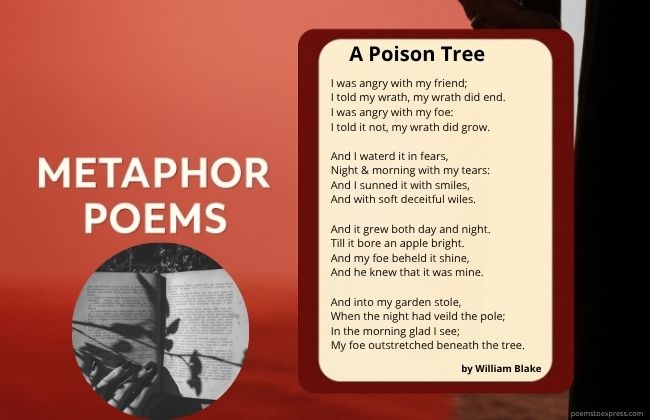
4. A Poison Tree by William Blake
The poem likens unspoken wrath to a tree, nurtured with fears, tears, and deceit, which grows into a poisonous entity.
The tree’s “bright apple” symbolizes the culmination of this anger, tempting the foe to their demise. Blake’s metaphor highlights how unresolved emotions can fester, corrupting both the individual and their relationships.
The biblical allusion to the Tree of Knowledge underscores themes of temptation and moral decay. Ultimately, the poem warns against harboring resentment, advocating for open communication to prevent the devastating consequences of bottled-up emotions.
I was angry with my friend;
I told my wrath, my wrath did end.
I was angry with my foe:
I told it not, my wrath did grow.

And I waterd it in fears,
Night & morning with my tears:
And I sunned it with smiles,
And with soft deceitful wiles.

And it grew both day and night.
Till it bore an apple bright.
And my foe beheld it shine,
And he knew that it was mine.

And into my garden stole,
When the night had veild the pole;
In the morning glad I see;
My foe outstretched beneath the tree.
5. Metaphors by Sylvia Plath
The poet uses several metaphors to describe the complex experience of pregnancy. The speaker compares herself to different objects, such as “an elephant” or “a melon strolling on two tendrils,” to show how her body feels large and unwieldy.
The line “I’m a means, a stage, a cow in calf” highlights the speaker’s feeling of being a vessel for the baby, emphasizing her role as a mother-to-be rather than as an individual.
The last metaphor, “Boarded the train there’s no getting off,” suggests that pregnancy and motherhood are inevitable and permanent. Through these metaphors, Plath explores the physical and emotional challenges of becoming a mother.
I'm a riddle in nine syllables,
An elephant, a ponderous house,
A melon strolling on two tendrils.
O red fruit, ivory, fine timbers!
This loaf's big with its yeasty rising.
Money's new-minted in this fat purse.
I'm a means, a stage, a cow in calf.
I've eaten a bag of green apples,
Boarded the train there's no getting off.
6. “Hope” is the thing with feathers by Emily Dickinson
The poem uses an extended metaphor to liken hope to a bird. This bird, delicate yet resilient, perches in the soul and sings continuously, even amidst life’s fiercest storms.
Dickinson’s metaphor emphasizes hope’s unwavering presence and its ability to uplift during adversity. The bird’s song, described as sweetest in the gale, symbolizes hope’s strength in challenging times. Furthermore, the bird’s selflessness—never asking for a “crumb”—highlights hope’s unconditional nature.
Through this vivid imagery, Dickinson transforms an abstract concept into a tangible, relatable force, urging readers to cherish hope as an essential, enduring part of the human spirit.
“Hope” is the thing with feathers -
That perches in the soul -
And sings the tune without the words -
And never stops - at all -

And sweetest - in the Gale - is heard -
And sore must be the storm -
That could abash the little Bird
That kept so many warm -

I’ve heard it in the chillest land -
And on the strangest Sea -
Yet - never - in Extremity,
It asked a crumb - of me.
7. O Captain! My Captain! by Walt Whitman
The uses an extended metaphor to mourn the death of President Abraham Lincoln. The “Captain” represents Lincoln, the “ship” symbolizes the United States, and the “fearful trip” refers to the Civil War.
The poem describes the ship’s victorious return to port, celebrating the Union’s triumph, only to reveal that the captain lies dead on the deck. This juxtaposition of victory and loss underscores the nation’s grief over Lincoln’s assassination.
Whitman’s metaphor conveys the deep sorrow felt by the American people, highlighting the personal and national tragedy of losing a leader who guided them through a tumultuous period.
O Captain! my Captain! our fearful trip is done,
The ship has weather’d every rack, the prize we sought is won,
The port is near, the bells I hear, the people all exulting,
While follow eyes the steady keel, the vessel grim and daring;
                         But O heart! heart! heart!
                            O the bleeding drops of red,
                               Where on the deck my Captain lies,
                                  Fallen cold and dead.

O Captain! my Captain! rise up and hear the bells;
Rise up—for you the flag is flung—for you the bugle trills,
For you bouquets and ribbon’d wreaths—for you the shores a-crowding,
For you they call, the swaying mass, their eager faces turning;
                         Here Captain! dear father!... See full poem
8. When I Have Fears that I May Cease to Be by John Keats
John Keats’ “When I Have Fears That I May Cease to Be” explores the poet’s existential dread of dying before fulfilling his creative and romantic aspirations.
Through rich metaphors, Keats likens his mind to fertile farmland, with his pen as a scythe harvesting poetic thoughts. This extended metaphor underscores his fear of leaving his ideas unexpressed, symbolizing the fragility of human ambition.
When I have fears that I may cease to be
   Before my pen has gleaned my teeming brain,
Before high-pilèd books, in charactery,
   Hold like rich garners the full ripened grain;
When I behold, upon the night’s starred face,
   Huge cloudy symbols of a high romance,
And think that I may never live to trace
   Their shadows with the magic hand of chance;
And when I feel, fair creature of an hour,
   That I shall never look upon thee more,
Never have relish in the faery power
   Of unreflecting love—then on the shore
Of the wide world I stand alone, and think
Till love and fame to nothingness do sink.
9. Marrysong by Dennis Scott
Dennis Scott’s “Marrysong” uses an extended metaphor of shifting landscapes to explore the complexities of marriage. The wife’s emotions are likened to unpredictable terrain—“wilderness,” “changing shores,” and “quarried hurt”—emphasizing her dynamic and enigmatic nature.
The husband’s attempts to “chart” her personality fail, as her emotional “map” is never static. This metaphor highlights the challenges of understanding a partner fully.
However, the poem concludes with acceptance; the husband embraces the “constantly strange geography” of her mind, finding love in the journey rather than the destination.
He never learned her, quite. Year after year
That territory, without seasons, shifted
under his eye. An hour he could be lost
in the walled anger of her quarried hurt
on turning, see cool water laughing where
the day before there were stones in her voice.
He charted. She made wilderness again.
Roads disappeared. The map was never true.
Wind brought him rain sometimes, tasting of sea –
and suddenly she would change the shape of shores
faultlessly calm. All, all was each day new;
the shadows of her love shortened or grew
like trees seen from an unexpected hill,
new country at each jaunty helpless journey.
So he accepted that geography, constantly strange.
Wondered. Stayed home increasingly to find
his way among the landscapes of her mind.
What Are Metaphor Poems?
A metaphor poem is a type of poetry where metaphors—figures of speech that directly compare two unlike things without using “like” or “as“—are the primary tool for expression. Unlike literal descriptions, metaphors create vivid imagery and emotional resonance by equating one thing to another, often revealing hidden similarities or deeper truths.
For example, in Emily Dickinson’s poem, she writes, “Hope is the thing with feathers.” Here, hope is not literally a bird, but the metaphor evokes its lightness, freedom, and uplifting nature.
Characteristics of Metaphor Poems:
- Direct Comparison: Metaphors state that one thing is another, e.g., “Time is a thief.”
- Imagery-Driven: They rely on vivid, sensory images to engage the reader’s imagination.
- Emotional Depth: Metaphors often convey complex emotions or abstract concepts in relatable terms.
- Compact and Evocative: A single metaphor can encapsulate an entire idea or feeling.
Difference Between Metaphor and Simile in Poetry
While both metaphors and similes are figures of speech used to draw comparisons, they differ in structure and effect.
Key Differences
| Aspect | Metaphor | Simile |
| Definition | A direct comparison, stating one thing is another. | A comparison using “like” or “as.” |
| Example | “Life is a journey.” | “Life is like a journey.” |
| Effect | More assertive and seamless, creating a stronger emotional impact. | Softer and explicit, emphasizing similarity rather than equivalence. |
| Usage in Poetry | Often used for deeper, symbolic meaning. | Used for clarity and to highlight specific similarities. |
Role of Figurative Language in Poetry
Figurative language, including metaphors, similes, personification, and more, is the backbone of poetic expression. It elevates poetry beyond literal descriptions, allowing poets to convey complex ideas and emotions in a compact, imaginative way.
Why Figurative Language Matters
- Enhances Imagery: It paints vivid pictures in the reader’s mind, making abstract concepts tangible.
- Conveys Emotion: Figurative language captures feelings that might be hard to express directly.
- Creates Layers of Meaning: It invites readers to interpret poems on multiple levels, from surface imagery to deeper symbolism.
- Engages the Reader: By sparking imagination, it makes poetry memorable and relatable.
Influential Poets Famous for Metaphor Usage
Several poets have mastered the art of metaphor, using it to create timeless works that resonate across generations. Below are some notable examples, their contributions, and signature metaphors.
1. William Shakespeare (1564–1616)
Known for his plays and sonnets, Shakespeare used metaphors to explore human nature, love, and mortality.
- Famous Metaphor: “All the world’s a stage, / And all the men and women merely players” (from As You Like It).
- Why It Stands Out: This metaphor frames life as a theatrical performance, highlighting its fleeting and performative nature.
- Notable Work: Sonnet 18 (“Shall I compare thee to a summer’s day?”) uses extended metaphors to compare beauty to nature.
2. Emily Dickinson (1830–1886)
Dickinson’s introspective poetry often uses metaphors to explore abstract concepts like hope, death, and eternity.
- Famous Metaphor: “Hope is the thing with feathers / That perches in the soul.”
- Why It Stands Out: The metaphor of hope as a bird captures its delicate yet enduring quality.
- Notable Work: “Because I could not stop for Death” personifies death as a carriage driver, a metaphor for life’s inevitable end.
3. Pablo Neruda (1904–1973)
The Chilean poet’s vivid metaphors often blend love, nature, and political themes.
- Famous Metaphor: “I want to do with you what spring does with the cherry trees” (from Every Day You Play).
- Why It Stands Out: This metaphor evokes the transformative, blossoming power of love.
- Notable Work: Twenty Love Poems and a Song of Despair is rich with metaphors of nature and passion.
4. Sylvia Plath (1932–1963)
Contribution: Plath’s confessional poetry uses stark, visceral metaphors to explore mental health, identity, and femininity.
- Famous Metaphor: “I am a riddle in nine syllables” (from Metaphors).
- Why It Stands Out: This metaphor describes pregnancy in a cryptic, layered way, reflecting its complexity.
- Notable Work: Ariel contains poems like “Lady Lazarus,” where metaphors of rebirth and destruction abound.
You might also like: