Love has been a popular theme in poetry for centuries, and many famous poets have written beautiful love poems that have stood the test of time.

These poetic works have the power to articulate the inexplicable feelings that often accompany love, resonating with readers and speaking to the universal experience of giving and receiving affection.
From Shakespeare to Allan Poe, there are countless love poems that have captured the hearts of readers worldwide. Each poem offers a unique perspective on love, and many have become beloved for their timeless themes and beautiful language.
Whether you’re a poetry enthusiast or simply a hopeless romantic, these famous love poems are sure to inspire you.
In this article, we will explore 10 of the best and most famous love poems that have left a lasting imprint on literature and in the hearts of those who have read them.
1) “Sonnet 18” by William Shakespeare
William Shakespeare’s “Sonnet 18” is one of the most celebrated poems in English literature, brilliantly showcasing the theme of love.
In this poem, Shakespeare compares the beauty of a person to a summer’s day, describing how the beauty of his beloved surpasses even that of the warmest and most pleasant season.
Throughout the sonnet, the poet explores profound themes such as love, beauty, and immortality.
The comparison to summer is not just a display of affection but also a reflection on the fleeting nature of life and how poetry can immortalize beauty and human feelings, preserving them beyond the passage of time.
Its simple language and profound sentiment continue to resonate with readers centuries after its first publication in 1609.

"Sonnet 18"

Shall I compare thee to a summer's day?
Thou art more lovely and more temperate:
Rough winds do shake the darling buds of May,
And summer's lease hath all too short a date:
Sometime too hot the eye of heaven shines,
And often is his gold complexion dimm'd;
And every fair from fair sometime declines,
By chance or nature's changing course untrimm'd;
But thy eternal summer shall not fade
Nor lose possession of that fair thou owest;
Nor shall Death brag thou wanderest in his shade,
When in eternal lines to time thou growest:
So long as men can breathe or eyes can see,
So long lives this, and this gives life to thee.
2) “The Love Song of J. Alfred Prufrock” by T.S. Eliot
This work diverges from traditional love poems, adopting a stream-of-consciousness technique to delve into the psyche of its speaker, Prufrock.
Through this method, Eliot captures the complexities and insecurities that define modern existential anguish.
Free verse, irregular rhyme schemes, and shifts in tempo and style are among the characteristics reflecting the poem’s modernist qualities.
These techniques serve to express the protagonist’s fluctuating thought processes and the typical alienation of the societal landscape of the early 20th century.
"The Love Song of J. Alfred Prufrock"

Let us go then, you and I,
When the evening is spread out against the sky
Like a patient etherized upon a table;
Let us go, through certain half-deserted streets,
The muttering retreats
Of restless nights in one-night cheap hotels
And sawdust restaurants with oyster-shells:
Streets that follow like a tedious argument
Of insidious intent
To lead you to an overwhelming question ...
Oh, do not ask, “What is it?”
Let us go and make our visit.

In the room the women come and go
Talking of Michelangelo.

The yellow fog that rubs its back upon the window-panes,
The yellow smoke that rubs its muzzle on the window-panes,
Licked its tongue into the corners of the evening,
Lingered upon the pools that stand in drains,
Let fall upon its back the soot that falls from chimneys,
Slipped by the terrace, made a sudden leap,
And seeing that it was a soft October night,
Curled once about the house, and fell asleep.


And indeed there will be time
For the yellow smoke that slides along the street,
Rubbing its back upon the window-panes;
There will be time, there will be time
To prepare a face to meet the faces that you meet;
There will be time to murder and create,
And time for all the works and days of hands
That lift and drop a question on your plate;
Time for you and time for me,
And time yet for a hundred indecisions,
And for a hundred visions and revisions,
Before the taking of a toast and tea.

In the room the women come and go
Talking of Michelangelo.

And indeed there will be time
To wonder, “Do I dare?” and, “Do I dare?”
Time to turn back and descend the stair,
With a bald spot in the middle of my hair —
(They will say: “How his hair is growing thin!”)
My morning coat, my collar mounting firmly to the chin,
My necktie rich and modest, but asserted by a simple pin —
(They will say: “But how his arms and legs are thin!”)
Do I dare
Disturb the universe?
In a minute there is time
For decisions and revisions which a minute will reverse.

For I have known them all already, known them all:
Have known the evenings, mornings, afternoons,
I have measured out my life with coffee spoons;
I know the voices dying with a dying fall
Beneath the music from a farther room.
               So how should I presume?

And I have known the eyes already, known them all—
The eyes that fix you in a formulated phrase,
And when I am formulated, sprawling on a pin,
When I am pinned and wriggling on the wall,
Then how should I begin
To spit out all the butt-ends of my days and ways?
               And how should I presume?

And I have known the arms already, known them all—
Arms that are braceleted and white and bare
(But in the lamplight, downed with light brown hair!)
Is it perfume from a dress
That makes me so digress?
Arms that lie along a table, or wrap about a shawl.
               And should I then presume?
               And how should I begin?

Shall I say, I have gone at dusk through narrow streets
And watched the smoke that rises from the pipes
Of lonely men in shirt-sleeves, leaning out of windows? ...

I should have been a pair of ragged claws
Scuttling across the floors of silent seas.

And the afternoon, the evening, sleeps so peacefully!
Smoothed by long fingers,
Asleep ... tired ... or it malingers,
Stretched on the floor, here beside you and me.
Should I, after tea and cakes and ices,
Have the strength to force the moment to its crisis?
But though I have wept and fasted, wept and prayed,
Though I have seen my head (grown slightly bald) brought in upon a platter,
I am no prophet — and here’s no great matter;
I have seen the moment of my greatness flicker,
And I have seen the eternal Footman hold my coat, and snicker,
And in short, I was afraid.

And would it have been worth it, after all,
After the cups, the marmalade, the tea,
Among the porcelain, among some talk of you and me,
Would it have been worth while,
To have bitten off the matter with a smile,
To have squeezed the universe into a ball
To roll it towards some overwhelming question,
To say: “I am Lazarus, come from the dead,
Come back to tell you all, I shall tell you all”—
If one, settling a pillow by her head
               Should say: “That is not what I meant at all;
               That is not it, at all.”

And would it have been worth it, after all,
Would it have been worth while,
After the sunsets and the dooryards and the sprinkled streets,
After the novels, after the teacups, after the skirts that trail along the floor—
And this, and so much more?—
It is impossible to say just what I mean!
But as if a magic lantern threw the nerves in patterns on a screen:
Would it have been worth while
If one, settling a pillow or throwing off a shawl,
And turning toward the window, should say:
               “That is not it at all,
               That is not what I meant, at all.”

No! I am not Prince Hamlet, nor was meant to be;
Am an attendant lord, one that will do
To swell a progress, start a scene or two,
Advise the prince; no doubt, an easy tool,
Deferential, glad to be of use,
Politic, cautious, and meticulous;
Full of high sentence, but a bit obtuse;
At times, indeed, almost ridiculous—
Almost, at times, the Fool.

I grow old ... I grow old ...
I shall wear the bottoms of my trousers rolled.

Shall I part my hair behind?   Do I dare to eat a peach?
I shall wear white flannel trousers, and walk upon the beach.
I have heard the mermaids singing, each to each.

I do not think that they will sing to me.
I have seen them riding seaward on the waves
Combing the white hair of the waves blown back
When the wind blows the water white and black.
We have lingered in the chambers of the sea
By sea-girls wreathed with seaweed red and brown
Till human voices wake us, and we drown.
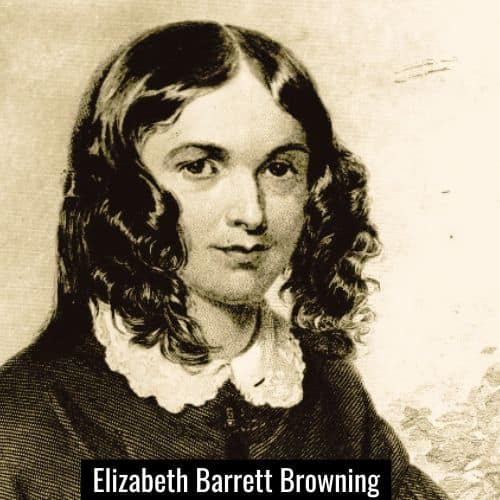
3) “How Do I Love Thee?” by Elizabeth Barrett Browning
Browning uses anaphora, the repetition of a phrase at the beginning of consecutive lines, to emphasize the numerous ways in which she adores her husband. Through the repeated phrase “I love you,” the poet highlights the depth and purity of her affection.
The poet’s love transcends the physical realm, suggesting a lasting bond. Furthermore, she articulates her love in terms of daily necessity and righteous action, illustrating that her love is as indispensable as daily sustenance and as ethical as the pursuit of justice.
It resonates with readers for its sincerity and its universal representation of a powerful and enveloping love that withstands the passage of time and transcends the self.

"How Do I Love Thee?"

How do I love thee? Let me count the ways.
I love thee to the depth and breadth and height
My soul can reach, when feeling out of sight
For the ends of being and ideal grace.
I love thee to the level of every day’s
Most quiet need, by sun and candle-light.
I love thee freely, as men strive for right;
I love thee purely, as they turn from praise.
I love thee with the passion put to use
In my old griefs, and with my childhood’s faith.
I love thee with a love I seemed to lose
With my lost saints. I love thee with the breath,
Smiles, tears, of all my life; and, if God choose,
I shall but love thee better after death.
4) “The Raven” by Edgar Allan Poe
“The Raven” by Edgar Allan Poe is a poem that explores themes of melancholy, loneliness, and loss. Narrated in the first person, the poem tells the story of a man grieving over the death of his beloved Lenore.
On a cold December night, while seeking solace in his books, he hears a gentle tapping. Upon opening the door to investigate, he encounters a raven that enters his house and perches on the bust of Pallas Athena.
The narrator asks the raven for its name, and the bird responds “Nevermore.” This encounter triggers a series of questions from the narrator, ranging from the raven’s name to inquiries about the possibility of being reunited with Lenore in the afterlife.
To each question, the raven replies with “Nevermore,” plunging the narrator into a spiral of despair.
The poem is notable for its meter, the use of the refrain “Nevermore,” and its dark, gothic atmosphere. Poe employs the raven, traditionally a symbol associated with death and the malevolent, to personify the relentless torment of grief and the inevitability of oblivion.
"The Raven"

Once upon a midnight dreary, while I pondered, weak and weary,
Over many a quaint and curious volume of forgotten lore—
    While I nodded, nearly napping, suddenly there came a tapping,
As of some one gently rapping, rapping at my chamber door.
“’Tis some visitor,” I muttered, “tapping at my chamber door—
            Only this and nothing more.”

    Ah, distinctly I remember it was in the bleak December;
And each separate dying ember wrought its ghost upon the floor.
    Eagerly I wished the morrow;—vainly I had sought to borrow
    From my books surcease of sorrow—sorrow for the lost Lenore—
For the rare and radiant maiden whom the angels name Lenore—
            Nameless here for evermore.

    And the silken, sad, uncertain rustling of each purple curtain
Thrilled me—filled me with fantastic terrors never felt before;
    So that now, to still the beating of my heart, I stood repeating
    “’Tis some visitor entreating entrance at my chamber door—
Some late visitor entreating entrance at my chamber door;—
            This it is and nothing more.”

    Presently my soul grew stronger; hesitating then no longer,
“Sir,” said I, “or Madam, truly your forgiveness I implore;
    But the fact is I was napping, and so gently you came rapping,
    And so faintly you came tapping, tapping at my chamber door,
That I scarce was sure I heard you”—here I opened wide the door;—
            Darkness there and nothing more.

    Deep into that darkness peering, long I stood there wondering, fearing,
Doubting, dreaming dreams no mortal ever dared to dream before;
    But the silence was unbroken, and the stillness gave no token,
    And the only word there spoken was the whispered word, “Lenore?”
This I whispered, and an echo murmured back the word, “Lenore!”—
            Merely this and nothing more.

    Back into the chamber turning, all my soul within me burning,
Soon again I heard a tapping somewhat louder than before.
    “Surely,” said I, “surely that is something at my window lattice;
      Let me see, then, what thereat is, and this mystery explore—
Let my heart be still a moment and this mystery explore;—
            ’Tis the wind and nothing more!”

    Open here I flung the shutter, when, with many a flirt and flutter,
In there stepped a stately Raven of the saintly days of yore;
    Not the least obeisance made he; not a minute stopped or stayed he;
    But, with mien of lord or lady, perched above my chamber door—
Perched upon a bust of Pallas just above my chamber door—
            Perched, and sat, and nothing more.

Then this ebony bird beguiling my sad fancy into smiling,
By the grave and stern decorum of the countenance it wore,
“Though thy crest be shorn and shaven, thou,” I said, “art sure no craven,
Ghastly grim and ancient Raven wandering from the Nightly shore—
Tell me what thy lordly name is on the Night’s Plutonian shore!”
            Quoth the Raven “Nevermore.”

    Much I marvelled this ungainly fowl to hear discourse so plainly,
Though its answer little meaning—little relevancy bore;
    For we cannot help agreeing that no living human being
    Ever yet was blessed with seeing bird above his chamber door—
Bird or beast upon the sculptured bust above his chamber door,
            With such name as “Nevermore.”

    But the Raven, sitting lonely on the placid bust, spoke only
That one word, as if his soul in that one word he did outpour.
    Nothing farther then he uttered—not a feather then he fluttered—
    Till I scarcely more than muttered “Other friends have flown before—
On the morrow he will leave me, as my Hopes have flown before.”
            Then the bird said “Nevermore.”

    Startled at the stillness broken by reply so aptly spoken,
“Doubtless,” said I, “what it utters is its only stock and store
    Caught from some unhappy master whom unmerciful Disaster
    Followed fast and followed faster till his songs one burden bore—
Till the dirges of his Hope that melancholy burden bore
            Of ‘Never—nevermore’.”

    But the Raven still beguiling all my fancy into smiling,
Straight I wheeled a cushioned seat in front of bird, and bust and door;
    Then, upon the velvet sinking, I betook myself to linking
    Fancy unto fancy, thinking what this ominous bird of yore—
What this grim, ungainly, ghastly, gaunt, and ominous bird of yore
            Meant in croaking “Nevermore.”

    This I sat engaged in guessing, but no syllable expressing
To the fowl whose fiery eyes now burned into my bosom’s core;
    This and more I sat divining, with my head at ease reclining
    On the cushion’s velvet lining that the lamp-light gloated o’er,
But whose velvet-violet lining with the lamp-light gloating o’er,
            She shall press, ah, nevermore!

    Then, methought, the air grew denser, perfumed from an unseen censer
Swung by Seraphim whose foot-falls tinkled on the tufted floor.
    “Wretch,” I cried, “thy God hath lent thee—by these angels he hath sent thee
    Respite—respite and nepenthe from thy memories of Lenore;
Quaff, oh quaff this kind nepenthe and forget this lost Lenore!”
            Quoth the Raven “Nevermore.”

    “Prophet!” said I, “thing of evil!—prophet still, if bird or devil!—
Whether Tempter sent, or whether tempest tossed thee here ashore,
    Desolate yet all undaunted, on this desert land enchanted—
    On this home by Horror haunted—tell me truly, I implore—
Is there—is there balm in Gilead?—tell me—tell me, I implore!”
            Quoth the Raven “Nevermore.”

    “Prophet!” said I, “thing of evil!—prophet still, if bird or devil!
By that Heaven that bends above us—by that God we both adore—
    Tell this soul with sorrow laden if, within the distant Aidenn,
    It shall clasp a sainted maiden whom the angels name Lenore—
Clasp a rare and radiant maiden whom the angels name Lenore.”
            Quoth the Raven “Nevermore.”

    “Be that word our sign of parting, bird or fiend!” I shrieked, upstarting—
“Get thee back into the tempest and the Night’s Plutonian shore!
    Leave no black plume as a token of that lie thy soul hath spoken!
    Leave my loneliness unbroken!—quit the bust above my door!
Take thy beak from out my heart, and take thy form from off my door!”
            Quoth the Raven “Nevermore.”

    And the Raven, never flitting, still is sitting, still is sitting
On the pallid bust of Pallas just above my chamber door;
    And his eyes have all the seeming of a demon’s that is dreaming,
    And the lamp-light o’er him streaming throws his shadow on the floor;
And my soul from out that shadow that lies floating on the floor
            Shall be lifted—nevermore!
5) “Annabel Lee” by Edgar Allan Poe
“Annabel Lee” is a poem that recounts the devotion and profound pain caused by the premature death of an idealized love.
The poem is narrated from the perspective of a man who reminisces about his youthful love with Annabel Lee, a girl who lived in a kingdom by the sea.
According to the narrator, their love was so intense and pure that even the angels in heaven envied them and, for this reason, conspired to separate them.
The central tragedy of the poem is the death of Annabel Lee, who dies under mysterious circumstances and is taken away by her family, burying her in a sepulcher by the sea.
However, the narrator proclaims that neither the demons nor death can truly separate their souls, suggesting that their love transcends even death.
Poe employs a lyrical structure with melodious rhyme and rhythm that evokes a sense of lament and melancholy.
The sea is presented as a persistent symbol throughout the poem, representing both the beauty of love and the vastness and desolation of loss.
"Annabel Lee"

It was many and many a year ago,
   In a kingdom by the sea,
That a maiden there lived whom you may know
   By the name of Annabel Lee;
And this maiden she lived with no other thought
   Than to love and be loved by me.

I was a child and she was a child,
   In this kingdom by the sea,
But we loved with a love that was more than love—
   I and my Annabel Lee—
With a love that the wingèd seraphs of Heaven
   Coveted her and me.

And this was the reason that, long ago,
   In this kingdom by the sea,
A wind blew out of a cloud, chilling
   My beautiful Annabel Lee;
So that her highborn kinsmen came
   And bore her away from me,
To shut her up in a sepulchre
   In this kingdom by the sea.

The angels, not half so happy in Heaven,
   Went envying her and me—
Yes!—that was the reason (as all men know,
   In this kingdom by the sea)
That the wind came out of the cloud by night,
   Chilling and killing my Annabel Lee.

But our love it was stronger by far than the love
   Of those who were older than we—
   Of many far wiser than we—
And neither the angels in Heaven above
   Nor the demons down under the sea
Can ever dissever my soul from the soul
   Of the beautiful Annabel Lee;

For the moon never beams, without bringing me dreams
   Of the beautiful Annabel Lee;
And the stars never rise, but I feel the bright eyes
   Of the beautiful Annabel Lee;
And so, all the night-tide, I lie down by the side
   Of my darling—my darling—my life and my bride,
   In her sepulchre there by the sea—
   In her tomb by the sounding sea.
6) “A Red, Red Rose” by Robert Burns
“A Red, Red Rose” is a poem that celebrates the beauty and intensity of true love through vivid comparisons and metaphors.
The poet compares his love for his beloved to a freshly bloomed red rose in June, highlighting the freshness and depth of his feelings. Additionally, he expresses the enduring nature of his love by likening it to a journey so long that it extends beyond the seas and to the end of time.
The poem is structured into four quatrains and employs a regular rhyme scheme that contributes to its melodic and harmonious tone.
Burns uses simple yet powerful language to convey a passion that is both fiery and tender.
This poem is widely regarded as one of the most romantic in Scottish literature, celebrated for its ability to capture the timeless essence of true love.
"A Red, Red Rose"

O my Luve is like a red, red rose
   That’s newly sprung in June;
O my Luve is like the melody
   That’s sweetly played in tune.

So fair art thou, my bonnie lass,
   So deep in luve am I;
And I will luve thee still, my dear,
   Till a’ the seas gang dry.

Till a’ the seas gang dry, my dear,
   And the rocks melt wi’ the sun;
I will love thee still, my dear,
   While the sands o’ life shall run.

And fare thee weel, my only luve!
   And fare thee weel awhile!
And I will come again, my luve,
   Though it were ten thousand mile.
7) “She Walks in Beauty” by Lord Byron
The poem celebrates the harmonious beauty of a woman, highlighting not only her physical attractiveness but also her inner grace.
The author begins by comparing the woman to a clear night with starry skies, suggesting a beauty that is serene and sublime.
Byron describes how darkness and light blend in her appearance, creating a perfect harmony of contrasts that enhances her charm.
Throughout the poem, Byron emphasizes the purity and peace that emanate from the woman, reflected in her calm expression and gentle smile. He portrays her as someone whose goodness and inner serenity manifest externally, suggesting that her beauty is a direct reflection of her virtuous soul.
The poem’s structure, with its regular meter and rhyme scheme, complements the theme of balance and perfection that Byron associates with the woman’s figure.
"She Walks in Beauty"

She walks in beauty, like the night
Of cloudless climes and starry skies;
And all that’s best of dark and bright
Meet in her aspect and her eyes;
Thus mellowed to that tender light
Which heaven to gaudy day denies.

One shade the more, one ray the less,
Had half impaired the nameless grace
Which waves in every raven tress,
Or softly lightens o’er her face;
Where thoughts serenely sweet express,
How pure, how dear their dwelling-place.

And on that cheek, and o’er that brow,
So soft, so calm, yet eloquent,
The smiles that win, the tints that glow,
But tell of days in goodness spent,
A mind at peace with all below,
A heart whose love is innocent!
8) “Dover Beach” by Matthew Arnold
“Dover Beach” is a poem that reflects on the uncertainty and disintegration of faith in the modern world, using natural landscape as a metaphor for emotional and spiritual changes.
The poem begins with a tranquil and beautiful description of Dover Beach at night, with the sea gently bringing the tide in a soft and melodious manner. However, this serene scene gives way to a darker reflection on the human condition.
Arnold describes the retreat of faith like the literal sea receding at Dover Beach, revealing bare and rough stones. This image symbolizes how the modern world has lost the certainty and light that faith once provided humanity.
The poet mentions the “sad confusion” of battles and struggles that now characterize human existence in the absence of this solid faith.
The tone of the poem becomes darker and more hopeless towards the end, where Arnold calls on his beloved to be faithful and true in a world that seems increasingly devoid of love and light.
"Dover Beach"

The sea is calm tonight.
The tide is full, the moon lies fair
Upon the straits; on the French coast the light
Gleams and is gone; the cliffs of England stand,
Glimmering and vast, out in the tranquil bay.
Come to the window, sweet is the night-air!
Only, from the long line of spray
Where the sea meets the moon-blanched land,
Listen! you hear the grating roar
Of pebbles which the waves draw back, and fling,
At their return, up the high strand,
Begin, and cease, and then again begin,
With tremulous cadence slow, and bring
The eternal note of sadness in.

Sophocles long ago
Heard it on the Ægean, and it brought
Into his mind the turbid ebb and flow
Of human misery; we
Find also in the sound a thought,
Hearing it by this distant northern sea.

The Sea of Faith
Was once, too, at the full, and round earth’s shore
Lay like the folds of a bright girdle furled.
But now I only hear
Its melancholy, long, withdrawing roar,
Retreating, to the breath
Of the night-wind, down the vast edges drear
And naked shingles of the world.

Ah, love, let us be true
To one another! for the world, which seems
To lie before us like a land of dreams,
So various, so beautiful, so new,
Hath really neither joy, nor love, nor light,
Nor certitude, nor peace, nor help for pain;
And we are here as on a darkling plain
Swept with confused alarms of struggle and flight,
Where ignorant armies clash by night.
9) “The Passionate Shepherd to His Love” by Christopher Marlowe
The poem stands out for its idealization of country life and pastoral love, free from the concerns of the urban or modern world.
The work begins with the famous line “Come live with me and be my love,” setting the romantic and persuasive tone for the rest of the poem.
Throughout the stanzas, the shepherd describes a life filled with rural delights: watching flocks graze on the hills, listening to the murmur of streams, and enjoying beds of roses.
Additionally, he promises gifts made of flowers, garments embroidered with straw and gold, and other natural decorations for his beloved, all to persuade her to share her life with him.
"The Passionate Shepherd to His Love"

Come live with me and be my love,
And we will all the pleasures prove,
That Valleys, groves, hills, and fields,
Woods, or steepy mountain yields.

And we will sit upon the Rocks,
Seeing the Shepherds feed their flocks,
By shallow Rivers to whose falls
Melodious birds sing Madrigals.

And I will make thee beds of Roses
And a thousand fragrant posies,
A cap of flowers, and a kirtle
Embroidered all with leaves of Myrtle;

A gown made of the finest wool
Which from our pretty Lambs we pull;
Fair lined slippers for the cold,
With buckles of the purest gold;

A belt of straw and Ivy buds,
With Coral clasps and Amber studs:
And if these pleasures may thee move,
Come live with me, and be my love.

The Shepherds’ Swains shall dance and sing
For thy delight each May-morning:
If these delights thy mind may move,
Then live with me, and be my love.
10) “To His Coy Mistress” by Andrew Marvell
“To His Coy Mistress” is a poem that explores themes of desire, the fleeting nature of time, and passion.

The work is structured as a logical argument, a type of “carpe diem,” where the poet tries to persuade his reluctant lover to seize the moment and embrace love before it’s too late.
The poem is divided into three parts. In the first, Marvell describes a hypothetical scenario where, if they had all the time in the world, he would spend centuries adoring every part of her body and her reluctance would be acceptable.
However, in the second part, he introduces a disturbing reality: they do not have all the time in the world. Marvell uses powerful imagery of time passing swiftly and inevitable death to illustrate the urgency of living and loving now.
In the final part of the poem, Marvell argues that since they cannot stop time, they should at least defy it by living intensely.
He proposes that they passionately embrace love, making the most of the time they have. The intensity and energy with which they love can, in a way, defy the constraints of their limited time.
"To His Coy Mistress"

Had we but world enough and time,
This coyness, lady, were no crime.
We would sit down, and think which way
To walk, and pass our long love’s day.
Thou by the Indian Ganges’ side
Shouldst rubies find; I by the tide
Of Humber would complain. I would
Love you ten years before the flood,
And you should, if you please, refuse
Till the conversion of the Jews.
My vegetable love should grow
Vaster than empires and more slow;
An hundred years should go to praise
Thine eyes, and on thy forehead gaze;
Two hundred to adore each breast,
But thirty thousand to the rest;
An age at least to every part,
And the last age should show your heart.
For, lady, you deserve this state,
Nor would I love at lower rate.
       But at my back I always hear
Time’s wingèd chariot hurrying near;
And yonder all before us lie
Deserts of vast eternity.
Thy beauty shall no more be found;
Nor, in thy marble vault, shall sound
My echoing song; then worms shall try
That long-preserved virginity,
And your quaint honour turn to dust,
And into ashes all my lust;
The grave’s a fine and private place,
But none, I think, do there embrace.
       Now therefore, while the youthful hue
Sits on thy skin like morning dew,
And while thy willing soul transpires
At every pore with instant fires,
Now let us sport us while we may,
And now, like amorous birds of prey,
Rather at once our time devour
Than languish in his slow-chapped power.
Let us roll all our strength and all
Our sweetness up into one ball,
And tear our pleasures with rough strife
Through the iron gates of life:
Thus, though we cannot make our sun
Stand still, yet we will make him run.
Key Themes in Famous Love Poems
Famous love poems often explore the complexities of the heart, addressing how love transcends time, the ache of love not returned, and the fervor of romantic desire.
Eternal Love
In literature, the theme of eternal love is frequently depicted as a force that defies the boundaries of time and mortality.
Poems like Shakespeare’s Sonnet 18, where the speaker claims his beloved’s eternal beauty shall not fade, offer a potent expression of love’s enduring power.
Similarly, “Annabel Lee” by Edgar Allan Poe emphasizes love’s ability to outlive even death, suggesting an everlasting bond between the souls of the lovers.
Unrequited Love
The pain of unrequited love is a poignant theme often encapsulated in the eloquent lines of poetry. It speaks to the experience of loving someone who does not return that affection.
Michael Drayton’s “Since There’s No Help” is a classic example, expressing the despair and acceptance of love’s defeat.
This theme resonates with readers who identify with the heartache of one-sided devotion.
Passion and Desire
Poems that delve into passion and desire capture love’s ability to consume the lover’s thoughts and senses.
Pablo Neruda’s “Love Sonnet XI”, with its rich and vivid imagery, paints a picture of intense and passionate love.
The theme is characterized by a powerful longing and an overwhelming connection to the beloved, often blurring the line between physical and emotional desire.
Influence of Famous Love Poems on Literature
Famous love poems have exerted a profound influence on the course of literature, shaping modern poetic expression and fostering connections between diverse literary cultures.
Impact on Modern Poetry
- Metrical and Thematic Innovations: The sonnets of William Shakespeare and the passionate intensity of poets like Elizabeth Barrett Browning have inspired contemporary poets to adopt and adapt traditional forms. Modern love poetry often weaves in the formal elegance of older works with new, experimental structures, creating a rich tapestry of verse that bridges centuries.
- Language and Imagery: The language of love in poetry, once pioneered by poets like Shakespeare, has evolved but continues to be a reference point. Metaphors and similes first penned hundreds of years ago still find echoes in today’s poetry, though often reimagined to fit the contemporary context.
Cross-Cultural Inspirations
- Global Reach: Love poems by poets from various nations have been translated and celebrated across the globe. Works like Pablo Neruda’s “Twenty Love Poems and a Song of Despair” resonate worldwide, influencing poets across different languages and literary traditions.
- Exchange of Poetic Techniques: The exchange of styles and themes among poets from different cultures has enriched the literary landscape. For example, the ghazals of Persian literature, which often touch on love, have found a place in Western poetry, introducing not only new content but also distinct poetic forms.
You might also like: