Meter in poetry is the rhythmic structure that arises from the arrangement of syllables into patterns of stressed and unstressed syllables. It is an essential component of verse and a tool that poets use to give their work a musical quality.
Understanding meter is fundamental to appreciating the artistry and complexity of poetic works.
Various types of meter have been employed by poets throughout history, and these create different effects and moods in their poems. Identifying and analyzing these patterns enriches the reading experience and reveals the intricacies of poetic composition
This post analyzes ten classic poems, each showcasing a distinct meter, to explore how poets use this device to enrich their works.
Let’s take a closer look at these poems, their meters, and the effects they create.
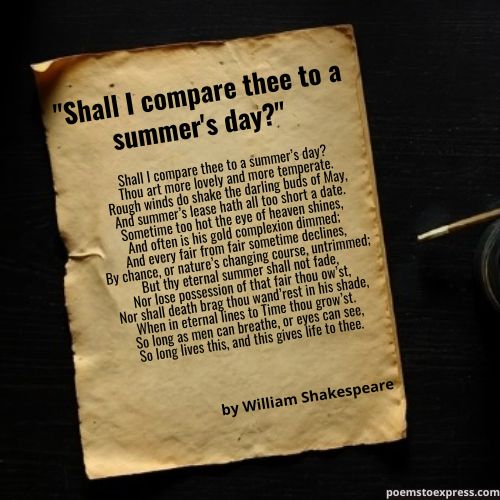
1) “Shall I compare thee to a summer’s day?” – William Shakespeare
In “Sonnet 18,” renowned poet William Shakespeare opens with one of the most famous lines in the English literary canon: “Shall I compare thee to a summer’s day?” This line not only introduces the poem but also sets the stage for an exploration of the theme through the use of iambic pentameter.
The meter is characterized by its unstressed-stressed syllabic pattern, typically seen in lines of five iambs, which Shakespeare skillfully employs to give the sonnet its rhythm and musicality.
The regularity of the iambic pentameter in “Shall I compare thee to a summer’s day?” mirrors the timelessness and consistency of the beauty described within.
Shakespeare’s use of meter, combined with the sonnet structure, effectively underscores the enduring nature of the beloved’s beauty contrasted against the fleeting quality of a summer day.
Shall I compare thee to a summer’s day?
Thou art more lovely and more temperate.
Rough winds do shake the darling buds of May,
And summer’s lease hath all too short a date.
Sometime too hot the eye of heaven shines,
And often is his gold complexion dimmed;
And every fair from fair sometime declines,
By chance, or nature’s changing course, untrimmed;
But thy eternal summer shall not fade,
Nor lose possession of that fair thou ow’st,
Nor shall death brag thou wand’rest in his shade,
When in eternal lines to Time thou grow’st.
    So long as men can breathe, or eyes can see,
    So long lives this, and this gives life to thee.
2) ” The Raven” – Edgar Allan Poe
The opening line of Edgar Allan Poe’s poem “The Raven” exemplifies masterful use of meter. “Once upon a midnight dreary” sets a trochaic octameter, a rhythm consisting of eight trochees per line.
Each trochee is a two-syllable unit with the stress on the first syllable, followed by an unstressed syllable.
Poe’s meticulous construction of the meter evokes a somber and rhythmic cadence that mirrors the poem’s melancholic theme.
The consistent meter helps to immerse the reader in the poem’s haunting atmosphere. The heavy beats at the beginning of each trochee, coupled with the more subdued second syllables, conjure an auditory experience that resembles a heart slowly beating in the stillness of night.
Poe’s choice of words further complements the rhythm; “dreary” resonates with a sense of exhaustion, enhancing the overall sense of weariness.
Once upon a midnight dreary, while I pondered, weak and weary,
Over many a quaint and curious volume of forgotten lore—
    While I nodded, nearly napping, suddenly there came a tapping,
As of some one gently rapping, rapping at my chamber door.
“’Tis some visitor,” I muttered, “tapping at my chamber door—
            Only this and nothing more.”

    Ah, distinctly I remember it was in the bleak December;
And each separate dying ember wrought its ghost upon the floor.
    Eagerly I wished the morrow;—vainly I had sought to borrow
    From my books surcease of sorrow—sorrow for the lost Lenore—
For the rare and radiant maiden whom the angels name Lenore—
            Nameless here for evermore… See full poem
3) “Because I could not stop for Death” – Emily Dickinson
Emily Dickinson employs a traditional meter to add a rhythmic quality to her poem “Because I could not stop for Death.” The meter is largely iambic tetrameter, which consists of four beats or iambs per line.
An iamb is a metrical foot with an unstressed syllable followed by a stressed syllable, as in the opening line: “Because I could not stop for Death.”
This use of meter creates a calm and measured pace, reflecting the poem’s representation of a gentle journey towards the afterlife.
Dickinson’s choice of meter also contributes to the uncanny contrast between the poem’s serene structure and its contemplation of mortality, effectively enhancing the work’s depth and resonance.
Because I could not stop for Death –
He kindly stopped for me –
The Carriage held but just Ourselves –
And Immortality.

We slowly drove – He knew no haste
And I had put away
My labor and my leisure too,
For His Civility –

We passed the School, where Children strove
At Recess – in the Ring –
We passed the Fields of Gazing Grain –
We passed the Setting Sun … See full poem
4) “Hope” is the thing with feathers – Emily Dickinson
Dickinson’s poem follows a common meter, which alternates between iambic tetrameter (eight syllables) and iambic trimeter (six syllables) across its stanzas.
This metric pattern is a hallmark of much of Dickinson’s poetry, contributing to its rhythmic and accessible feel while still allowing for varied and thoughtful expression.
The poem does exhibit variations in its metrical form which serve to enhance its thematic expression—emphasizing the resilience and omnipresence of hope even in challenging times.
These subtle shifts in rhythm can draw attention to specific lines or phrases, underscoring the poem’s deeper meanings about hope’s enduring presence and comfort in the human spirit.
“Hope” is the thing with feathers -
That perches in the soul -
And sings the tune without the words -
And never stops - at all -

And sweetest - in the Gale - is heard -
And sore must be the storm -
That could abash the little Bird
That kept so many warm -

I’ve heard it in the chillest land -
And on the strangest Sea -
Yet - never - in Extremity,
It asked a crumb - of me.
5) The Tyger by William Blake
In William Blake’s poem “The Tyger,” the opening line “Tyger Tyger, burning bright” is not just a memorable phrase but also a prime example of meter in poetry.
The line is written in trochaic tetrameter, characterized by a succession of trochees—metrical feet that consist of a stressed syllable followed by an unstressed one.
This meter imparts a rhythmic insistence to the verse, which mirrors the intensity of the subject, the majestic and fearsome tiger.
Blake’s use of meter is particularly effective at highlighting the tiger’s power and the awe it inspires, as well as the poem’s central themes of creation and existential inquiry.
The alliteration of the ‘b’ sound in “burning bright” adds to the poem’s musical quality, further emphasizing the tiger’s fierce and vivid presence.
Tyger Tyger, burning bright,
In the forests of the night;
What immortal hand or eye,
Could frame thy fearful symmetry?

In what distant deeps or skies.
Burnt the fire of thine eyes?
On what wings dare he aspire?
What the hand, dare seize the fire?... See full poem
6) Stopping by Woods on a Snowy Evening – Robert Frost
This line from Robert Frost’s “Stopping by Woods on a Snowy Evening” presents a classic example of iambic tetrameter, a type of meter in poetry.
In iambic tetrameter, each line typically contains four iambic feet, each foot consisting of an unstressed syllable followed by a stressed syllable.
The poem’s narrator reflects on the tranquil scene of watching snow fill a wood with a rhythmic pattern that contributes to the calm, contemplative mood of the poem.
Frost’s use of this meter is subtle, often employing natural speech patterns that softly guide the reader through the snowy landscape.
His mastery of meter weaves a gentle cadence that mirrors the quiet night, enhancing the imagery and sensory experience embedded in the verse.
The meter also adds to the element of solitude and introspection, as the regular beats create a sense of solitary reflection for both the speaker and the reader.
Whose woods these are I think I know.
His house is in the village though;
He will not see me stopping here
To watch his woods fill up with snow.

My little horse must think it queer
To stop without a farmhouse near
Between the woods and frozen lake
The darkest evening of the year.

He gives his harness bells a shake
To ask if there is some mistake.
The only other sound’s the sweep
Of easy wind and downy flake.

The woods are lovely, dark and deep,
But I have promises to keep,
And miles to go before I sleep,
And miles to go before I sleep.
7) “Do not go gentle into that good night” – Dylan Thomas
Dylan Thomas’s “Do not go gentle into that good night” stands as an exemplary piece exhibiting the intricate meter found in poetry.
This poem is a villanelle, tightly woven with a dual rhyme scheme that adheres to the form’s rigorous structure.
The poem is composed of five tercets followed by a concluding quatrain, each line predominantly written in iambic pentameter.
The meter in Thomas’s work is particularly steadfast, with the rhythmic pattern following an unstressed syllable followed by a stressed syllable, which epitomizes the traditional iambic meter.
This consistent beat creates an urgency, echoing the poem’s theme of fighting against the dying of the light. The poem’s refrain, “Do not go gentle into that good night,” and the alternating line, “Rage, rage against the dying of the light,” serve as anchors, around which the poem’s meter rhythmically revolves.
Do not go gentle into that good night,
Old age should burn and rave at close of day;
Rage, rage against the dying of the light.

Though wise men at their end know dark is right,
Because their words had forked no lightning they
Do not go gentle into that good night.

Good men, the last wave by, crying how bright
Their frail deeds might have danced in a green bay,
Rage, rage against the dying of the light… See full poem
8) Ulalume – Edgar Allan Poe
The poem is known for its use of anapestic trimeter predominantly, which involves three metrical feet per line, each foot having two unstressed syllables followed by a stressed one.
This meter contributes to the poem’s rapid and musical rhythm, fitting its haunting and mournful tone.
Poe also employs various sound devices like alliteration and assonance to enhance the musicality and incantatory effects, which are crucial to the poem’s eerie atmosphere.
The structure of “Ulalume” includes stanzas of varying lengths with a complex rhyme scheme that adds to its hypnotic quality.
These elements work together to create a dreamy, melancholic journey through a landscape filled with mythic and emotional significance, emphasizing the themes of lost love and mourning.
The skies they were ashen and sober;
      The leaves they were crispéd and sere—
      The leaves they were withering and sere;
It was night in the lonesome October
      Of my most immemorial year;
It was hard by the dim lake of Auber,
      In the misty mid region of Weir—
It was down by the dank tarn of Auber,
      In the ghoul-haunted woodland of Weir.

Here once, through an alley Titanic,
      Of cypress, I roamed with my Soul—
      Of cypress, with Psyche, my Soul.
These were days when my heart was volcanic
      As the scoriac rivers that roll—
      As the lavas that restlessly roll
Their sulphurous currents down Yaanek
      In the ultimate climes of the pole—
That groan as they roll down Mount Yaanek
      In the realms of the boreal pole… See full poem
9) I love the jocund dance – William Blake
I Love the Jocund Dance” by William Blake is a vivid exploration of joy and movement, encapsulated within the structured confines of iambic trimeter.
In this poem, each line consists typically of three iambic feet, where each foot comprises an unstressed syllable followed by a stressed one, creating a rhythmic cadence that mimics the dynamics of a lively dance.
This metrical arrangement not only enhances the musicality of the poem but also aligns perfectly with its celebratory content, reflecting the natural flow and energy of dancing.
Blake’s language is clear and evocative, enabling the reader to viscerally participate in the dance’s jubilance.
The poem thus serves as an ode to the spiritedness of dance, using a simple yet effective rhythmic structure to convey a sense of uninhibited freedom and joy.
I love the jocund dance,
The softly-breathing song,
Where innocent eyes do glance,
And where lisps the maiden's tongue.

I love the laughing vale,
I love the echoing hill,
Where mirth does never fail,
And the jolly swain laughs his fill.

I love the pleasant cot,
I love the innocent bow'r,
Where white and brown is our lot,
Or fruit in the mid-day hour.

I love the oaken seat
Beneath the oaken tree,
Where all the old villagers meet,
And laugh our sports to see.

I love our neighbours all,
But, Kitty, I better love thee;
And love them I ever shall;
But thou art all to me.
10) “Renascence” – Edna St. Vincent Millay
“Renascence” is known for its octosyllabic couplets, where each line consists of eight syllables, contributing to the rhythmic and lyrical flow of the poem.
This metrical structure complements the poem’s expansive themes, including spiritual awakening, the interconnectivity of life and nature, and personal transformation.
“Renascence” captures the narrator’s profound spiritual and emotional journey from despair to a transcendental understanding of the universe.
The poem’s meter plays a crucial role in enhancing its meditative and philosophical tone, inviting deep reflection on human suffering and the redemptive power of spiritual rebirth.
The consistent rhythm mirrors the narrator’s transformative experience, moving from a constrained perception to a liberated, infinite view of existence.
All I could see from where I stood
Was three long mountains and a wood;
I turned and looked another way,
And saw three islands in a bay.
So with my eyes I traced the line
Of the horizon, thin and fine,
Straight around till I was come
Back to where I'd started from;
And all I saw from where I stood
Was three long mountains and a wood… See full poem
Understanding Meter In Poetry
Meter in poetry is the structured pattern of rhythm that underscores the words, while its historical development is tied to the evolution of language and cultural expression.
Definition of Meter
Meter refers to the recurring pattern of stressed (*) and unstressed (u) syllables in lines of poetry. These patterns are known as “feet.” The most common metrical feet in English poetry are:
- Iamb (u*): An unstressed syllable followed by a stressed one, as in the word “delay.”
- Trochee (*u): A stressed syllable followed by an unstressed one, like “garden.”
- Anapest (uu*): Two unstressed syllables followed by a stressed one, found in the word “intervene.”
- Dactyl (*uu): A stressed syllable followed by two unstressed ones, as in “desperate.”
- Spondee (**): Two consecutive stressed syllables, often used for emphasis, such as “heartbreak.”
The number of feet in a line of poetry determines the meter’s name:
- Monometer: One foot
- Dimeter: Two feet
- Trimeter: Three feet
- Tetrameter: Four feet
- Pentameter: Five feet
- Hexameter: Six feet
Poets combine these metrics to give their poetry a particular rhythmic quality and emotional impact.
Historical Context
The origins of poetic meter can be traced back to ancient civilizations, where poetry often played a crucial role in oral traditions and storytelling.
Greek and Latin poetry, for instance, relied heavily on meter for their structures, influencing the poetry of subsequent European cultures.
With the rise of the printing press in the 15th century, poetry could be distributed more widely, cementing the importance of meter in the English literary canon. It became a marker of a poet’s skill and a tool to enhance the auditory aesthetic of poetry.
During the Renaissance, poets such as Shakespeare and Marlowe popularized the iambic pentameter, which became a hallmark of English poetry.
The Romantic poets of the 19th century, like Wordsworth and Shelley, adapted and sometimes rebelled against traditional metrics, while the free verse of the 20th century saw poets like Eliot and Frost play with meters to create unique rhythmic effects that aligned with modern sensibilities.
The Role Of Meter In Poetic Form
Meter serves as the scaffolding for verse, providing poems with a consistent rhythm and aiding in the conveyance of deeper meanings within the text.
Creating Rhythm
In poetry, meter is the organized succession of syllables at regular intervals of stressed (/) and unstressed (x) syllables, which constructs the rhythm of the poem.
Different types of meter, such as iambic pentameter—which consists of five iambs, or metrical feet, with each foot containing an unstressed syllable followed by a stressed one—contribute to distinct rhythmic qualities.
The rhythm created by the meter isn’t merely a musical pattern; it’s also a tool for poets to draw attention to specific words or themes and to give the poem a flow that can enhance its readability and recitation.
Enhancing Meaning
Poets often choose a specific meter to reinforce or complement the message and tone of the poem.
For example, a trochaic meter, where the line typically starts with a stressed syllable followed by an unstressed one, may impart a sense of urgency or emphasis.
The placement of stressed syllables within a metrical framework can also underscore the significance of particular words or phrases, thus layering additional meaning onto the literal words.
Similarly, breaking from the established meter can serve to highlight a change in emotion or introduce a jarring idea, proving that meter is integral not only in establishing patterns but also in manipulating them to add depth to the poetry.
You might also like: