Nature has long been one of the most powerful muses for poets around the world. From the gentle rustling of leaves in the wind to the grandeur of towering mountains and the endless mysteries of the sea, the natural world has inspired countless verses that capture its beauty, complexity, and transformative power.
Famous poets like William Wordsworth, Emily Dickinson, and Robert Frost have immortalized nature’s wonders, using vivid imagery and profound metaphors to reflect not only the world around us but also our deepest emotions and thoughts.
Through their words, we are invited to pause, observe, and reconnect with the environment that sustains us.
In this article, we will delve into some of the most celebrated poems that highlight nature’s influence on literature. Join us as we journey through these timeless verses that remind us of the beauty and significance of nature in our lives.
Poems about nature by famous poets
Stopping by Woods on a Snowy Evening by Robert Frost
The poem explores the tension between the allure of nature and the obligations of life. The speaker pauses during a winter journey to admire the serene beauty of snow-covered woods, symbolizing peace and introspection.
However, the repetition of the line “And miles to go before I sleep” serves as a poignant reminder of responsibilities and commitments that must be fulfilled before rest or death can be embraced. This duality reflects the human experience of balancing personal desires with societal duties.
Whose woods these are I think I know.
His house is in the village though;
He will not see me stopping here
To watch his woods fill up with snow.

My little horse must think it queer
To stop without a farmhouse near
Between the woods and frozen lake
The darkest evening of the year.

He gives his harness bells a shake
To ask if there is some mistake.
The only other sound’s the sweep
Of easy wind and downy flake.

The woods are lovely, dark and deep,
But I have promises to keep,
And miles to go before I sleep,
And miles to go before I sleep.
The Road Not Taken by Robert Frost
Robert Frost’s “The Road Not Taken” explores the idea of choices and their lasting impact. The speaker stands at a fork in the road, deciding which path to take, symbolizing important life decisions.
The poem reflects on how these decisions shape the future, and how the road not chosen can also hold significance. Frost’s use of a future “sigh” adds mystery, leaving it unclear whether the speaker feels regret or satisfaction about their choice.
This ambiguity encourages readers to think about their own decisions and how even small choices can influence their lives in unexpected ways.
Two roads diverged in a yellow wood,
And sorry I could not travel both
And be one traveler, long I stood
And looked down one as far as I could
To where it bent in the undergrowth;

Then took the other, as just as fair,
And having perhaps the better claim,
Because it was grassy and wanted wear;
Though as for that the passing there
Had worn them really about the same,

And both that morning equally lay
In leaves no step had trodden black.
Oh, I kept the first for another day!
Yet knowing how way leads on to way,
I doubted if I should ever come back.

I shall be telling this with a sigh
Somewhere ages and ages hence:
Two roads diverged in a wood, and I—
I took the one less traveled by,
And that has made all the difference.
I Wandered Lonely as a Cloud by William Wordsworth
The poem uses vivid imagery and personification to depict a field of daffodils as a source of joy and inspiration. Wordsworth likens the daffodils to stars, emphasizing their endless beauty and vitality.
The flowers’ “dancing” in the breeze symbolizes nature’s liveliness, while their golden hue conveys renewal and value. The poet’s memory of this scene becomes a wellspring of happiness, revisited during moments of solitude.
This Romantic masterpiece highlights nature’s ability to uplift the human spirit, urging readers to cherish its beauty and find solace in its simplicity.
I wandered lonely as a cloud
That floats on high o'er vales and hills,
When all at once I saw a crowd,
A host, of golden daffodils;
Beside the lake, beneath the trees,
Fluttering and dancing in the breeze.

Continuous as the stars that shine
And twinkle on the milky way,
They stretched in never-ending line
Along the margin of a bay:
Ten thousand saw I at a glance,
Tossing their heads in sprightly dance.

The waves beside them danced; but they
Out-did the sparkling waves in glee:
A poet could not but be gay,
In such a jocund company:
I gazed—and gazed—but little thought
What wealth the show to me had brought:

For oft, when on my couch I lie
In vacant or in pensive mood,
They flash upon that inward eye
Which is the bliss of solitude;
And then my heart with pleasure fills,
And dances with the daffodils.
To Autumn by John Keats
Through rich imagery, Keats personifies autumn as a collaborator with the sun, nurturing ripened fruits, swelling gourds, and blooming flowers.
The poem transitions from the season’s peak productivity to its tranquil decline, symbolizing life’s inevitable passage. Keats uses natural elements like bees, lambs, and swallows to highlight the interconnectedness of life and death, suggesting renewal through decay.
Ultimately, Keats invites us to embrace the fleeting beauty of nature, finding harmony in its rhythms and transformations.
Season of mists and mellow fruitfulness,
  Close bosom-friend of the maturing sun;
Conspiring with him how to load and bless
  With fruit the vines that round the thatch-eves run;
To bend with apples the moss’d cottage-trees,
  And fill all fruit with ripeness to the core;
    To swell the gourd, and plump the hazel shells
  With a sweet kernel; to set budding more,
And still more, later flowers for the bees,
Until they think warm days will never cease,
    For summer has o’er-brimm’d their clammy cells.
Who hath not seen thee oft amid thy store?
  Sometimes whoever seeks abroad may find
Thee sitting careless on a granary floor,
  Thy hair soft-lifted by the winnowing wind;
Or on a half-reap’d furrow sound asleep, .. See full poem
Tulips by Sylvia Plath
Sylvia Plath’s “Tulips” explores the tension between life and death through vivid natural imagery.
The speaker, recovering in a sterile hospital room, finds solace in the white, quiet environment, symbolizing detachment and peace. However, the arrival of vibrant red tulips disrupts this calm, representing the vitality and chaos of life.
The tulips’ “breathing” and “redness” evoke both the speaker’s physical wound and emotional struggles, forcing her to confront her existence. Plath uses metaphors like the tulips as “red lead sinkers” to depict the weight of life’s responsibilities.
The tulips are too excitable, it is winter here.
Look how white everything is, how quiet, how snowed-in.
I am learning peacefulness, lying by myself quietly
As the light lies on these white walls, this bed, these hands.
I am nobody; I have nothing to do with explosions.
I have given my name and my day-clothes up to the nurses
And my history to the anesthetist and my body to surgeons.

They have propped my head between the pillow and the sheet-cuff
Like an eye between two white lids that will not shut.
Stupid pupil, it has to take everything in.
The nurses pass and pass, they are no trouble,
They pass the way gulls pass inland in their white caps,
Doing things with their hands, one just the same as another,
So it is impossible to tell how many there are. .. See full poem
The Darkling Thrush by Thomas Hardy
Thomas Hardy’s The Darkling Thrush is a classic nature poem that opens on a bleak winter landscape, a desolate scene symbolizing the world in decline.
The land is frozen and lifeless, even likened to the “Century’s corpse,” intensifying the sense that all warmth has vanished. This barren countryside mirrors the speaker’s despair at the end of an era.
Then a frail thrush suddenly sings a joyful song amid the gloom. The bird’s music becomes a symbol of hope piercing despair. Hardy suggests that even in the darkest times, nature’s small voices like the thrush can inspire renewed hope—a stark contrast between the lifeless environment and the joyful bird.
I leant upon a coppice gate
      When Frost was spectre-grey,
And Winter's dregs made desolate
      The weakening eye of day.
The tangled bine-stems scored the sky
      Like strings of broken lyres,
And all mankind that haunted nigh
      Had sought their household fires.

The land's sharp features seemed to be
      The Century's corpse outleant,
His crypt the cloudy canopy,
      The wind his death-lament.
The ancient pulse of germ and birth
      Was shrunken hard and dry,
And every spirit upon earth
      Seemed fervourless as I.

At once a voice arose among
      The bleak twigs overhead
In a full-hearted evensong
      Of joy illimited;
An aged thrush, frail, gaunt, and small,
      In blast-beruffled plume,
Had chosen thus to fling his soul
      Upon the growing gloom.

So little cause for carolings
      Of such ecstatic sound
Was written on terrestrial things
      Afar or nigh around,
That I could think there trembled through
      His happy good-night air
Some blessed Hope, whereof he knew
      And I was unaware.
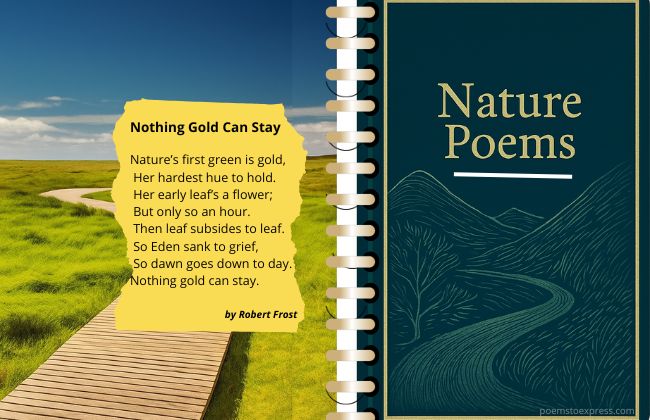
Nothing Gold Can Stay by Robert Frost
The poem begins with the golden hue of early spring leaves, symbolizing youth and purity, which quickly fades as nature transitions.
Frost’s imagery of leaves, dawn, and the Garden of Eden reflects the inevitability of change and loss.
The poem’s brevity mirrors its theme: beauty and perfection are transient, much like the golden moments in nature. By personifying nature and employing vivid symbolism, Frost emphasizes the preciousness of ephemeral beauty, urging readers to cherish these fleeting moments.
Nature’s first green is gold,
Her hardest hue to hold.
Her early leaf’s a flower;
But only so an hour.
Then leaf subsides to leaf.
So Eden sank to grief,
So dawn goes down to day.
Nothing gold can stay.
The Tyger by William Blake
“The Tyger” is William Blake’s famous 1794 poem that uses vivid natural imagery to explore creation’s dual nature. Blake describes a tiger “burning bright in the forests of the night,” an image that evokes wonder and fear in equal measure. The tiger symbolizes both beauty and terror—nature’s power, at once majestic and unsettling.
Blake wonders what kind of divine creator could forge such a fearsome and awe-inspiring creature. He even asks, “Did he who made the Lamb make thee?” to contrast the tiger’s ferocity with the lamb’s innocence and emphasize creation’s duality.
Ultimately, the poem expresses awe at the untamed wildness of nature and suggests that truly appreciating the natural world means accepting both its fierce and gentle sides.
Tyger! Tyger! burning bright
In the forests of the night,
What immortal hand or eye
Could frame thy fearful symmetry?
In what distant deeps or skies
Burnt the fire of thine eyes?
On what wings dare he aspire?
What the hand, dare sieze the fire?
And what shoulder, & what art,
Could twist the sinews of thy heart?
And when thy heart began to beat,
What dread hand? & what dread feet? … See full poem
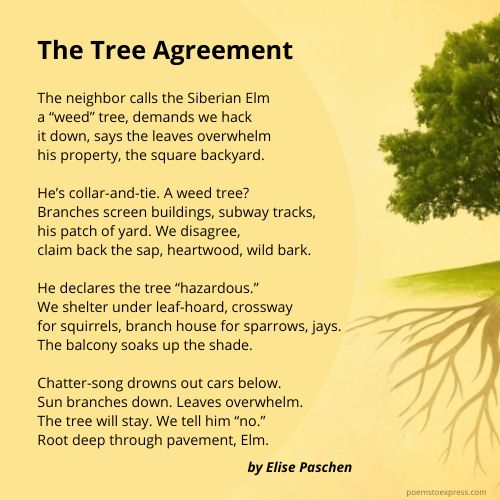
The Tree Agreement by Elise Paschen
Elise Paschen’s The Tree Agreement is a contemporary nature poem that depicts a conflict with a neighbor over a Siberian elm. The neighbor calls the elm a “weed” and wants it removed, but the speaker—using a collective “we”—refuses and extols the tree’s virtues.
Paschen uses vivid imagery to emphasize the elm’s value: its leaves offer shade, its branches house sparrows and squirrels, and birdsong from its canopy drowns out city noise. By portraying the tree as “a beautiful element of nature shooting up in the middle of a city”, the poem delivers an impassioned message of conservation.
The final line (“Root deep through pavement, Elm”) evokes nature’s perseverance, urging readers to protect nature’s essential benefits.
The neighbor calls the Siberian Elm
a “weed” tree, demands we hack
it down, says the leaves overwhelm
his property, the square backyard.

He’s collar-and-tie. A weed tree?
Branches screen buildings, subway tracks,
his patch of yard. We disagree,
claim back the sap, heartwood, wild bark.

He declares the tree “hazardous.”
We shelter under leaf-hoard, crossway
for squirrels, branch house for sparrows, jays.
The balcony soaks up the shade.

Chatter-song drowns out cars below.
Sun branches down. Leaves overwhelm.
The tree will stay. We tell him “no.”
Root deep through pavement, Elm.
What Defines Poems About Nature?
Nature poetry is a timeless and diverse genre that explores the natural world—its landscapes, creatures, seasons, and phenomena—through vivid language and powerful emotion.
These poems celebrate, reflect upon, and sometimes question humanity’s relationship with nature, using evocative imagery and thoughtful themes to connect readers with the environment.
Core Themes in Nature Poetry
Nature poetry often revolves around recurring themes that reflect both the natural world and human experience. These themes provide depth and universality, making the poems relatable across cultures and eras.
1. Beauty and Awe
Nature’s splendor—its landscapes, seasons, and creatures—often inspires awe. Poets use vivid descriptions to evoke the sublime, from towering mountains to delicate wildflowers.
- Example: William Wordsworth’s I Wandered Lonely as a Cloud celebrates the joy of encountering a field of daffodils, capturing nature’s ability to uplift the human spirit.
- This theme reminds readers of nature’s capacity to inspire wonder and provide solace.
2. Transience and Change
Nature’s cycles—seasons, life, and death—mirror the impermanence of human existence. Poets often reflect on time’s passage and the fleeting quality of beauty.
- Example: Robert Frost’s Nothing Gold Can Stay uses the brief bloom of spring to explore the ephemerality of life.
- This theme connects readers to universal truths about mortality and change.
3. Interconnectedness
Many nature poems emphasize humanity’s place within the natural world, highlighting interdependence between people, animals, and ecosystems.
- Example: Mary Oliver’s Wild Geese invites readers to find their place in the “family of things,” emphasizing unity with nature.
- This theme fosters environmental awareness and a sense of responsibility.
4. Solitude and Reflection
Nature often serves as a backdrop for introspection, offering a space for poets to explore personal emotions or philosophical questions.
- Example: Emily Dickinson’s A Bird came down the Walk uses a simple encounter with a bird to delve into themes of observation and existence.
- This theme underscores nature’s role as a catalyst for self-discovery.
Summary of themes:
| Theme | Description | Example Poem |
| Beauty and Awe | Celebrates nature’s splendor and its emotional impact. | I Wandered Lonely as a Cloud |
| Transience and Change | Reflects on the fleeting nature of life and beauty. | Nothing Gold Can Stay |
| Interconnectedness | Explores humanity’s connection to the natural world. | Wild Geese |
| Solitude and Reflection | Uses nature as a setting for personal or philosophical reflection. | A Bird came down the Walk |
Personification and Imagery in Nature Poems
Personification and imagery are central to nature poetry, transforming landscapes and creatures into vivid, relatable entities that resonate with readers.
Personification
Personification attributes human qualities to non-human elements, making nature feel alive and relatable.
- How it works: Poets give natural elements emotions, actions, or intentions, such as a “whispering wind” or a “dancing river.”
- Example: In Percy Bysshe Shelley’s Ode to the West Wind, the wind is portrayed as a powerful, almost divine force that “drivest the dead leaves” and scatters the poet’s thoughts.
- Effect: This device bridges the gap between humans and nature, fostering empathy and connection.
Imagery
Imagery uses descriptive language to create vivid sensory experiences, appealing to sight, sound, touch, smell, and taste.
- How it works: Poets craft detailed pictures, like the “frosted breath of morning” or the “crisp scent of pine.”
- Example: In John Keats’ To Autumn, phrases like “mellow fruitfulness” and “soft-dying day” evoke the sights, sounds, and feelings of fall.
- Effect: Imagery immerses readers in the poem’s world, making nature tangible and emotionally impactful.
Literary Devices in Nature Poetry
Beyond personification and imagery, nature poets employ a range of literary devices to enhance meaning and emotional depth.
Here are the most common:
1. Metaphor and Simile
- Metaphor: Compares two unlike things directly (e.g., “The forest is a cathedral”).
- Simile: Uses “like” or “as” for comparison (e.g., “The river flows like a silver ribbon”).
- Example: In The World Is Too Much With Us, Wordsworth uses metaphor to lament humanity’s disconnection from nature, describing it as a lost “suckling” bond.
- Purpose: These devices draw parallels between nature and human experience, deepening the poem’s resonance.
2. Alliteration
- Definition: Repetition of initial consonant sounds (e.g., “wild winds weave”).
- Example: Gerard Manley Hopkins’ The Windhover uses alliteration (“dapple-dawn-drawn Falcon”) to mimic the rhythm of a bird’s flight.
- Purpose: Enhances musicality and emphasizes key images or emotions.
3. Symbolism
- Definition: Uses objects or elements to represent larger ideas (e.g., a tree symbolizing growth or resilience).
- Example: In Stopping by Woods on a Snowy Evening, Frost’s woods symbolize temptation and the pull of introspection.
- Purpose: Adds layers of meaning, inviting readers to interpret beyond the literal.
4. Enjambment
- Definition: The continuation of a sentence across lines without a pause.
- Example: Walt Whitman’s Song of Myself uses enjambment to mimic the boundless energy of nature and life.
- Purpose: Creates a flowing, organic rhythm that mirrors nature’s continuity.
You might also like: